


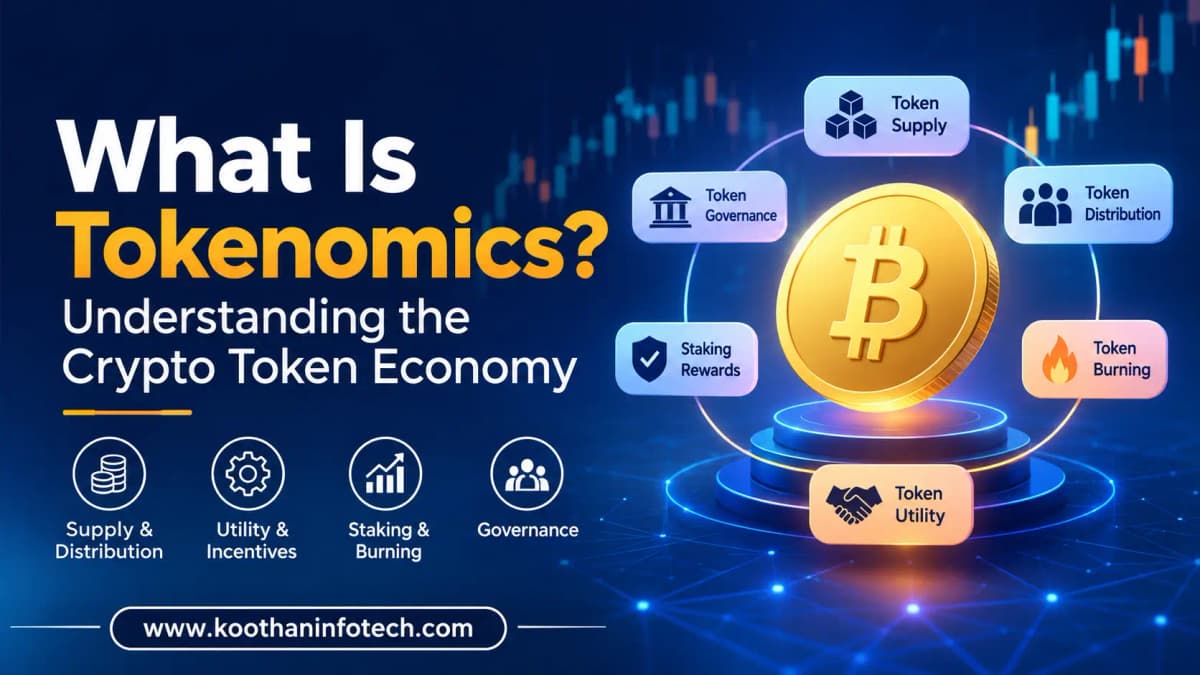
Launching a cryptocurrency involves more than creating a token and listing it on an exchange. A project needs a clear economic structure that defines how tokens are created, distributed, used, and managed. This structure is called tokenomics.
Tokenomics explains a cryptocurrency's supply, distribution, utility, and incentives. It helps businesses plan how tokens will function within their blockchain ecosystem.
For example, a payment platform may use tokens for transactions, while a decentralised application may use them for platform access or governance.In this guide, Koothan Infotech explains tokenomics, its key components, supply models, and how businesses can design an economic model for their cryptocurrency projects.
What Is Tokenomics?
Tokenomics is the combination of two words: token and economics. It refers to the economic structure of a cryptocurrency, including its supply, distribution, utility, incentives, and governance.
In simple terms, tokenomics explains how a cryptocurrency works from an economic perspective. It establishes the rules that determine how tokens enter circulation, how people use them, and how the project's economic activities are managed.
A tokenomics model generally answers the following questions:
How many tokens will the project create?
Is there a maximum token supply?
Who will receive the initial token allocation?
What purpose does the token serve?
How will users earn or purchase tokens?
Will the project introduce staking or token-burning mechanisms?
How will new tokens enter circulation?
What happens to tokens held by founders and early investors?
Can token holders participate in governance?
Consider a blockchain-based gaming platform. Its token may allow players to purchase in-game items, receive rewards, access special features, or participate in platform decisions. The tokenomics model determines how many tokens are available, how rewards are distributed, and how the platform manages its token supply.
Therefore, tokenomics is not simply about deciding the price of a cryptocurrency. It involves planning the complete economic structure that supports the project's business model and user activities.
Why Is Tokenomics Important in Cryptocurrency Projects?
A cryptocurrency project may have a functional blockchain application, but that alone does not explain why users should hold or use its token. The economic model provides this connection.Tokenomics helps project owners define the relationship between token supply, user demand, platform activities, and participant incentives.
Here are some important reasons why tokenomics matters.
1. Establishes a Clear Token Supply
A tokenomics plan defines how many tokens will be created and whether additional tokens can be issued in the future.
For example, a project may establish a maximum supply of 100 million tokens. This gives users and investors a reference point for understanding the total number of tokens that can exist.The project must also explain whether the supply is fixed or whether new tokens can be introduced through a predefined issuance mechanism.
2. Defines the Token's Purpose
Every cryptocurrency token should have a clearly explained function within its ecosystem.A token may support payments, platform access, staking, governance, or rewards. Defining these functions helps users understand why the token exists and how it connects to the project's services.
A token without a practical purpose may struggle to generate consistent demand from actual platform users.
3. Supports Fair Token Distribution
Tokenomics establishes how the available supply is divided among founders, development teams, investors, community members, and ecosystem activities.A clearly documented allocation plan helps participants understand who controls the supply and when different groups can access their tokens.
It also allows project owners to plan community participation without allocating an excessive portion of the supply to a single group.
4. Manages Token Release Over Time
Releasing a large number of tokens into circulation within a short period may create selling pressure.A vesting schedule allows projects to release allocated tokens gradually. This is particularly important for team members, advisors, and early investors.
The schedule should be explained before the token launch so that participants can understand future supply changes.
5. Aligns Participant Incentives
A blockchain ecosystem may include developers, validators, investors, service providers, and regular users.
Tokenomics can define incentives for each group based on its contribution. For example, validators may receive staking rewards, while users may earn tokens for completing specific platform activities.The incentive structure should support actual project requirements rather than distribute rewards without a clear economic purpose.
What Are the Main Components of Tokenomics?
A tokenomics model consists of several interconnected components. Each one influences how the cryptocurrency operates and how participants interact with the project.
1. Total Token Supply
Total supply refers to the number of tokens that have been created, excluding tokens that have already been permanently burned.
For example, if a cryptocurrency project creates 50 million tokens and later burns 2 million, its total supply becomes 48 million tokens.
Project owners must decide the initial supply based on the intended use of the token, expected platform activity, distribution requirements, and future development plans.
A higher token supply does not automatically make a cryptocurrency more affordable or valuable. The number of tokens must be considered alongside the project's market valuation, circulation, and demand.
2. Maximum Token Supply
Maximum supply represents the highest number of tokens that can ever exist under the project's current rules.
Some cryptocurrencies have a fixed supply limit, while others allow additional issuance through smart contracts or protocol-level mechanisms.
For example, Bitcoin has a maximum supply of 21 million BTC. This limit is part of its monetary design.
A project creating its own token must decide whether a supply cap is appropriate for its business model. If the project requires ongoing rewards for validators or users, it may need an issuance mechanism that supports those activities.
3. Circulating Supply
Circulating supply refers to the number of tokens currently available for public use and trading.
Not all created tokens immediately enter circulation. Some may remain locked in vesting contracts, treasury wallets, team allocations, or ecosystem reserves.
For example, assume a project has created 100 million tokens. However, only 25 million are currently available to the public. Its circulating supply is 25 million tokens.
This figure is useful when evaluating the current market capitalisation of a cryptocurrency.
4. Token Allocation
Token allocation explains how the total token supply is divided among different participants and project requirements.
A cryptocurrency project may distribute tokens across the following categories:
Development team: Tokens allocated to founders, developers, and other core team members who work on the project.
Early investors: Tokens reserved for angel investors, venture capital firms, and other early funding participants.
Public sale: Tokens made available to eligible participants through a public token sale.
Community rewards: Tokens distributed to users who contribute to the platform, participate in campaigns, or support community activities.
Marketing and partnerships: Tokens reserved for business partnerships, promotional campaigns, and user acquisition activities.
Ecosystem development: Funds allocated to application developers, technical contributors, integrations, and other ecosystem initiatives.
Treasury reserve: Tokens held for future operational expenses, development requirements, and approved project activities.
There is no single allocation percentage that works for every cryptocurrency. The distribution should reflect the project's funding needs, business model, decentralisation plans, and expected ecosystem participation.The allocation percentages should also be published clearly so users can understand how the supply is divided.
5. Token Vesting Schedule
Token vesting determines when allocated tokens become available to their recipients.It is commonly used for founder, team, advisor, and early investor allocations. Instead of releasing the complete allocation immediately, the project makes tokens transferable according to a predefined schedule.
A vesting plan may include two important elements:
Cliff period: The initial period during which allocated tokens remain locked and cannot be transferred.
Vesting period: The duration over which the locked tokens are gradually released.
For example, a project may allocate 10 million tokens to its development team with a six-month cliff and a 24-month vesting period.
Under this arrangement, the team receives no transferable tokens during the initial six months. After the cliff, tokens are released according to the agreed schedule.
Vesting reduces the possibility of a large allocation entering circulation immediately after launch. However, it does not guarantee price stability because market demand, liquidity, and other factors also influence trading activity.
6. Token Utility
Token utility refers to the functions a cryptocurrency performs within its platform or blockchain ecosystem.A well-defined utility model explains why users need the token and what services or activities require it.
Common token utility models include:
Payment utility: Users pay for products, services, or transactions using the token.
Governance utility: Token holders participate in voting on eligible project proposals.
Staking utility: Users lock tokens to participate in network security or receive protocol-defined rewards.
Access utility: Holding or spending tokens provides access to specific platform features.
Reward utility: Users receive tokens for completing activities or contributing to the ecosystem.
Transaction fee utility: Tokens are used to pay network fees or execute blockchain operations.
For instance, a decentralised application may require users to spend its native token to access premium services. This creates a direct connection between platform usage and token demand.
However, project owners should avoid adding unnecessary utility functions simply to make a token appear more attractive. Every function should have a clear connection to the platform's operations.
7. Token Burning Mechanism
Token burning is the process of permanently removing cryptocurrency tokens from circulation.A project may send tokens to a verifiably inaccessible blockchain address or use a protocol-level mechanism that permanently reduces the available supply.
Token burning can serve different purposes:
Reducing the circulating or total supply.
Removing tokens collected through specific platform activities.
Implementing a predefined economic policy.
Adjusting the supply according to network usage.
For example, a project may collect a portion of transaction fees and burn those tokens according to its published rules.
Ethereum provides a well-known example through EIP-1559, which introduced the burning of the base fee associated with transactions.
Burning does not automatically increase a token's market price. Its effect depends on the amount burned, remaining supply, user demand, and overall market conditions.
8. Staking and Rewards
Staking allows cryptocurrency holders to lock their tokens for a specific purpose, depending on the blockchain or protocol design.In proof-of-stake networks, validators commit tokens to participate in network consensus and help secure transactions. They may receive protocol-defined rewards for their participation.
Some projects also provide staking mechanisms through decentralised applications.
A tokenomics plan should explain:
Minimum staking requirements.
Staking duration.
Reward calculation method.
Withdrawal conditions.
Lock-up periods.
Penalties, if applicable.
Source of staking rewards.
For example, a platform may offer rewards to participants who lock their tokens for a specified period. The project must identify where these rewards come from, whether through new issuance, platform fees, or another defined source.
Unfunded reward promises can create problems when the project does not have sufficient economic activity to support them.
9. Token Governance
Governance refers to the process through which decisions about a blockchain project are proposed, discussed, and approved.Some projects allow token holders to vote on selected decisions, such as protocol upgrades, treasury spending, or changes to platform parameters.
A governance model should clearly define:
Who can submit proposals.
Who is eligible to vote.
How voting power is calculated.
How long voting remains open.
What percentage of participation is required.
How approved proposals are implemented.
For example, a decentralised finance platform may allow eligible token holders to vote on changes to its transaction fee structure.
Governance rights should be described accurately. Holding a cryptocurrency token does not automatically provide ownership in the company or legal rights to its profits.
What Are the Different Token Supply Models?
Token supply models determine how the number of tokens changes over time. Choosing the appropriate model depends on the project's purpose and economic requirements.
1. Fixed Supply Model
A fixed supply model establishes a predetermined maximum number of tokens.Once the complete supply has been created, no additional tokens can be issued under the established rules.
For example, a project may create 10 million tokens and set this as the permanent maximum supply.
Projects that prioritise predictable supply.
Digital assets designed around scarcity.
Platforms that do not require continuous token issuance.
Consideration: A fixed supply does not guarantee demand or price appreciation. The project must still establish a useful reason for people to acquire and use the token.
2. Inflationary Supply Model
An inflationary model allows new tokens to enter circulation over time.New tokens may be issued to reward validators, support network security, fund ecosystem development, or compensate participants for specific activities.
For example, a blockchain network may issue new tokens every year to reward validators who participate in transaction verification.
The project should define the issuance rate and explain how additional supply will affect existing token holders.
Proof-of-stake blockchain networks.
Platforms requiring continuous participant incentives.
Projects that need recurring ecosystem rewards.
3. Deflationary Supply Model
A deflationary model includes mechanisms designed to reduce the available token supply over time.Token burning is one of the most common approaches.For example, a project may burn a portion of the tokens collected through transaction fees. If the number of tokens removed exceeds the number of newly issued tokens, the total supply can decrease.
Projects with established transaction activity.
Platforms that use fee-based token-burning mechanisms.
Ecosystems with a clearly defined supply reduction policy.
The actual supply movement must be measured rather than assumed from the project's use of the word deflationary.
4. Hybrid Supply Model
A hybrid model combines multiple supply mechanisms.For example, a project may issue new tokens to reward validators while burning a portion of transaction fees.In this case, the overall supply depends on the relationship between new issuance and tokens removed from circulation.
This model can be useful when a project needs both recurring incentives and a mechanism to manage its supply.
Project owners must publish the rules for issuance and burning so participants can understand how the supply may change.
How Does Tokenomics Work? A Practical Example
Consider a startup planning to launch a blockchain-based digital service platform.The business wants to create a utility token that users can spend on platform services, while also allowing eligible participants to receive rewards for contributing to the ecosystem.
The startup decides to create a maximum supply of 100 million tokens.
Step 1: Define token utility
Users can spend tokens to access eligible services on the platform. The token may also support selected reward programmes.
Step 2: Establish the distribution plan
The startup publishes how tokens are allocated to the team, investors, community, and other project requirements.
Step 3: Create vesting conditions
The development team's allocation remains locked according to a published vesting schedule. Early investor allocations also follow agreed release conditions.
Step 4: Introduce user incentives
Eligible users can receive tokens for completing activities that contribute to platform usage and community participation.
Step 5: Define supply management
The project specifies whether additional tokens can be issued and whether transaction-related token burning will be implemented.
Step 6: Publish the tokenomics documentation
The startup explains the complete supply, allocation, utility, vesting, and governance structure in its project documentation.
Through this process, the business establishes an economic framework that connects token distribution with its actual platform activities.
How to Design Tokenomics for a New Cryptocurrency Project?
Designing tokenomics requires an understanding of the project's business model, technical requirements, target users, and long-term operating expenses.
Here is a practical approach for businesses planning to create their own cryptocurrency.
1. Identify the Business Purpose
Start by identifying why the project needs a cryptocurrency token.
Is the token intended for payments, platform access, governance, staking, rewards, or another specific function?
The business purpose should come before decisions about token supply or distribution.
For example, a blockchain gaming business may need tokens for in-game purchases and player rewards. A decentralised finance platform may require a token for governance or protocol participation.
2. Select the Blockchain Network
The blockchain network affects how the token is created, transferred, and integrated with other applications.
Businesses should compare networks based on:
Transaction fees.
Transaction processing speed.
Smart contract support.
Wallet compatibility.
Security architecture.
Developer tools.
Ecosystem activity.
Integration requirements.
For a business comparing available options, this guide to selecting a blockchain network to create your crypto token can help explain the different network considerations.The selected network should support the project's technical requirements and expected user activities.
3. Decide the Total and Maximum Supply
Once the token's purpose and network are established, decide how many tokens need to be created.
The supply should be based on the intended economic model rather than an arbitrary large number.
Consider the expected number of users, transaction requirements, distribution plan, and future reward commitments.
4. Prepare the Token Allocation Plan
Divide the supply among the different project participants and operational requirements.
Document the allocation percentages and explain why each category receives its share.
Avoid making allocation decisions without considering the long-term impact on token ownership and governance.
5. Establish Vesting and Unlock Conditions
Decide when team members, investors, and other allocated participants can access their tokens.A published vesting schedule helps users understand upcoming token releases and makes the distribution plan easier to evaluate.
6. Define the Incentive Structure
Identify how users, validators, developers, and community contributors will participate in the ecosystem.
Rewards should be connected to measurable activities and supported by a clearly explained funding mechanism.
For instance, if users receive rewards for platform activity, the project should explain how those rewards are funded and how long the programme will operate.
7. Document the Economic Rules
Prepare tokenomics documentation covering:
Token name and symbol.
Blockchain network.
Initial and maximum supply.
Circulating supply.
Token allocation.
Vesting schedule.
Token utility.
Issuance policy.
Burning mechanism.
Staking conditions.
Governance rights.
The documentation should be consistent with the actual smart contract implementation. If a project's economic rules change, the documentation and communication should be updated accordingly.
Common Tokenomics Mistakes Businesses Should Avoid
An unclear economic model can create difficulties even when the underlying blockchain application works as intended.
Businesses should pay attention to the following mistakes before launching their tokens.
1. Creating Tokens Without a Clear Use Case
A token should have a defined purpose within the project. Simply issuing a cryptocurrency and expecting people to purchase it does not create sustainable demand.Explain what users can do with the token and why the platform requires it.
2. Allocating Too Many Tokens to Founders
A large allocation to founders and early investors can create concerns about ownership concentration and future selling pressure.
Businesses should prepare a distribution plan that accounts for development funding, community participation, and long-term project requirements.
3. Ignoring Future Token Unlocks
A token may have a limited circulating supply at launch but a much larger total supply waiting to be released.If the project does not communicate future unlocks, token holders may not understand the potential changes in available supply.
4. Offering Unsustainable Staking Rewards
Promising high staking rewards without identifying their source can create financial pressure.
Projects should calculate reward obligations and establish a funding mechanism before introducing staking programmes.
5. Treating Token Burning as a Price Guarantee
Burning tokens reduces supply, but it does not automatically create market demand.
A project still needs users, platform activity, and a genuine reason for people to acquire its token.
6. Ignoring Legal and Regulatory Requirements
The legal treatment of a cryptocurrency depends on its structure, rights, distribution method, intended use, and the jurisdictions involved.
Businesses should obtain appropriate legal advice before offering tokens, conducting public sales, or promoting investment-related benefits.
For projects operating in India or targeting international users, compliance requirements should be assessed separately for each relevant jurisdiction.
7. Failing to Communicate Tokenomics Clearly
A complicated tokenomics model can make it difficult for users to understand how a project operates.
Publish clear information about supply, allocation, vesting, token utility, and governance. Avoid unsupported claims about guaranteed returns or future token prices.
How to Evaluate the Tokenomics of a Cryptocurrency Before Investing?
Tokenomics is also useful for people researching a cryptocurrency before making an investment decision.
Instead of focusing only on the current market price, examine the economic information published by the project.
Here are some important checks.
Check the circulating supply: Compare circulating supply with total and maximum supply. A significant difference may indicate that additional tokens are waiting to enter circulation.
Review token allocation: Find out how much supply is assigned to the development team, early investors, public participants, and ecosystem reserves.
Study the vesting schedule: Check when locked tokens will become transferable. Pay attention to large unlock events.
Understand the token utility: Identify whether the token supports actual platform activities or is mainly promoted for speculative trading.
Examine staking rewards: Understand the reward source, lock-up conditions, and withdrawal rules.
Review governance: Check whether token holders have voting rights and how those rights are exercised.
Compare market capitalisation and FDV: Market capitalisation is generally calculated using circulating supply multiplied by the current token price. Fully diluted valuation (FDV) uses the maximum or fully diluted supply, depending on the project's supply structure.
For example, a token trading at $2 with 10 million tokens in circulation has a circulating market capitalisation of $20 million.
If its maximum supply is 100 million tokens, its fully diluted valuation at the same price would be $200 million.
This difference helps investors understand how the valuation compares with the supply that could eventually exist.
However, neither market capitalisation nor FDV should be considered a standalone measure of investment quality.
How Does Tokenomics Affect the Long-Term Growth of a Crypto Project?
Tokenomics influences how users, investors, developers, and other participants interact with a blockchain project.A clearly designed economic model can help a business establish predictable token distribution, communicate future supply changes, and connect incentives with platform activities.
For example, a project that provides a useful service may create demand through regular platform transactions. If its token is required for those transactions, the utility has a direct relationship with product usage.Similarly, a project that rewards validators through a defined issuance model can explain how network participation is supported.
However, tokenomics alone cannot determine whether a cryptocurrency project will succeed. Other factors include the quality of the product, technical security, user adoption, market competition, liquidity, governance, and regulatory requirements.
Businesses should therefore treat tokenomics as one part of a wider blockchain business plan rather than a replacement for product development and market research.
How Can Koothan Infotech Help Businesses With Crypto Token Development?
Planning a cryptocurrency requires decisions about both technical implementation and economic design. Businesses need to identify the token's purpose, select an appropriate blockchain network, define its supply structure, and document how it will function within the intended ecosystem.
The development planning process can cover:
Blockchain network selection: Reviewing available blockchain networks based on transaction requirements, smart contract compatibility, fees, and ecosystem support.
Token creation: Defining token standards and developing the smart contract required to create and manage the cryptocurrency.
Token supply configuration: Implementing the agreed initial supply, maximum supply, and other supported supply parameters.
Token distribution: Planning token allocation across team, investor, community, and ecosystem categories.
Vesting and locking mechanisms: Developing smart contract functionality for predefined token release and lock-up conditions.
Token utility integration: Connecting token functions with the intended platform activities, such as payments, access, rewards, or governance.
Smart contract testing: Testing token transfer functions, access permissions, supply controls, and other relevant contract operations before deployment.
The technical architecture should reflect the approved tokenomics documentation. Smart contract functionality, security testing, and legal review should be considered before a token is released to users.
For businesses planning a new cryptocurrency project, working with a cryptocurrency token development company can help translate the project's requirements into a technical development plan. The economic model and implementation should be reviewed together rather than treated as separate activities.
Conclusion
Tokenomics defines how a cryptocurrency's supply, distribution, utility, and incentives work. A well-planned economic model helps businesses manage token allocation, future supply, and user participation.
Before launching a cryptocurrency, businesses should establish clear token utility, transparent distribution rules, and properly tested smart contracts.
If you’re a business owner looking to create a new crypto token for your project, then feel free to schedule a call with our expert