


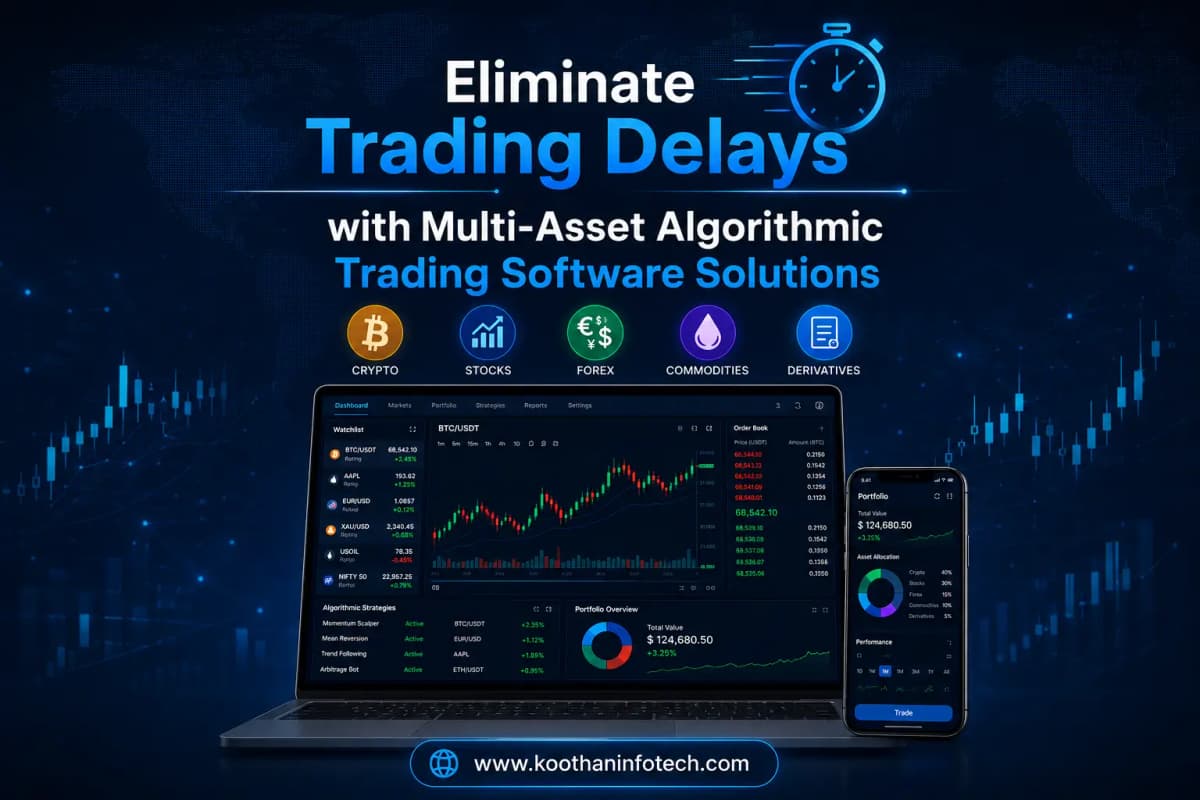
Open your crypto chart. A Bitcoin movement catches your attention.
Before you can act, stock markets begin reacting to global news.
A forex pair suddenly becomes volatile.
Meanwhile, commodity prices start shifting after economic updates.
You switch between tabs, open multiple dashboards, monitor alerts, and try to process everything at once.
Then it happens.
The opportunity is gone.
This is a challenge many traders and trading businesses face every day. It is not always because they lack market knowledge or experience. In many situations, the problem is timing.
Financial markets move faster than manual decision-making. Traders may have the right strategy, understand technical indicators, and identify patterns accurately. Yet when multiple markets move simultaneously, executing decisions manually becomes difficult.
Today's trading environment is no longer limited to a single market. Users actively participate across:
Cryptocurrency markets
Stock exchanges
Forex trading
Commodity markets
Derivatives
ETFs
Futures
Managing all of these manually often creates delays, emotional decisions, and missed opportunities.
That is why businesses, fintech startups, brokers, hedge funds, and institutional firms are increasingly investing in multi-asset algorithmic trading software.
Instead of watching charts continuously and reacting manually, businesses can use automated systems that analyze data, identify opportunities, execute strategies, and manage risks in real time.
This guide explains everything businesses need to know about multi-asset algorithmic trading software development, including its functionality, benefits, technology stack, features, development cost, and business advantages.
What is Multi-Asset Algorithmic Trading Software?
Multi-asset algorithmic trading software is a technology platform designed to automate trading activities across multiple financial markets through a unified system.
Rather than depending on manual order placement and continuous monitoring, the software executes trades using predefined rules and intelligent algorithms.
These systems process:
Live market data
Technical indicators
Trading signals
Historical trends
Risk parameters
User-defined strategies
Once market conditions satisfy the strategy rules, trades execute automatically.
Instead of relying on emotions or delayed reactions, trading decisions become data-driven and systematic.
The purpose is simple:
Reduce complexity and improve trading efficiency.
For businesses managing large trading operations, automation improves speed, consistency, and scalability.
Why Manual Trading Creates Limitations in Modern Markets?
A few years ago, monitoring a single market manually was manageable.
Today the trading environment looks very different.
Thousands of assets move simultaneously. Large amounts of market data arrive every second. Global events influence multiple asset classes instantly.
Human decision-making struggles to keep pace.
Several limitations frequently appear in manual trading environments.
Delayed Reactions
Markets change rapidly.
By the time traders analyze conditions and manually place orders, price movements may already change.
Emotional Decision Making
Fear and greed affect judgment.
Many traders hold positions too long or exit too early.
Difficulty Managing Multiple Markets
Tracking crypto, forex, stocks, and commodities at the same time becomes overwhelming.
Human Errors
Manual order placement can introduce mistakes such as:
Incorrect position sizes
Wrong order values
Missed entries
Delayed exits
Inconsistent Strategy Execution
Human behavior changes during volatile periods.
Algorithms execute rules consistently regardless of market conditions.
Multi Asset Algorithmic Trading Software Development
Multi-Asset Algorithmic Trading Software Development enables businesses and traders to automate trading strategies across multiple asset classes, including cryptocurrencies, stocks, forex, commodities, and derivatives. These platforms use advanced algorithms, real-time market data, and intelligent execution engines to analyze trends and execute trades with speed and accuracy. With features such as risk management tools, portfolio tracking, API integrations, and automated decision-making, businesses can reduce manual effort, improve trading efficiency, and capitalize on market opportunities across diverse financial markets.
Why Algorithmic Trading Has Become Important?
Algorithmic trading has become increasingly important because financial markets move much faster than human decision-making. Price movements, market sentiment, global events, and trading signals can change within seconds. Relying entirely on manual monitoring and execution often creates delays, inconsistent decisions, and missed opportunities.
Instead of constantly watching charts and reacting manually, algorithmic trading systems continuously monitor market conditions and execute predefined actions automatically. This allows traders and businesses to respond quickly and maintain consistency even during highly volatile market conditions.
As competition increases across crypto, stocks, forex, and commodity markets, speed and precision are no longer advantages; they are becoming essential requirements.
Faster Execution
Market opportunities can change within seconds. Algorithmic systems execute trades instantly when predefined conditions are met, helping traders react quickly and capture opportunities before markets shift.
Improved Accuracy
Manual trading can lead to errors during fast-moving conditions. Algorithms follow predefined rules consistently, improving execution accuracy and reducing human mistakes.
Continuous Market Monitoring
Markets operate continuously, making constant tracking difficult. Algorithmic trading software monitors multiple markets 24/7 and identifies opportunities without manual supervision.
Reduced Emotional Influence
Emotions like fear and greed can impact trading decisions. Automated systems remove emotional bias and execute trades based only on strategy rules.
Better Risk Management
Algorithmic systems include built-in controls to manage risk effectively, such as:
Stop-loss management
Position size limits
Exposure controls
Portfolio balancing
Risk allocation rules
This helps protect capital and maintain trading discipline.
Higher Operational Efficiency
Managing multiple assets manually can become difficult as operations grow. Algorithmic trading allows businesses to handle several strategies simultaneously while maintaining speed and consistency.
How Multi-Asset Algorithmic Trading Software Works?
Many businesses understand the concept of automated trading but often wonder how the actual process works behind the scenes. Multi-asset algorithmic trading software functions as an intelligent trading engine that continuously monitors markets, analyzes conditions, executes trades, manages risks, and improves performance over time.
Instead of relying on manual observation, the system follows a structured workflow designed to process large amounts of information quickly and make decisions based on predefined logic.
Step 1: Data Collection
The process begins with collecting market data from multiple sources. Since trading decisions depend heavily on accurate and timely information, the software continuously gathers real-time and historical data across different markets.
Data sources may include:
Exchange price feeds
Market depth information
Order books
Historical market records
Economic events and news updates
Technical indicators
By collecting and updating this information continuously, the platform creates a live trading environment where strategies always work with the latest market conditions. This helps improve responsiveness and decision-making accuracy.
Step 2: Signal Analysis
Once the data is collected, algorithms begin processing and analyzing it to identify meaningful patterns and opportunities. Instead of simply displaying charts, the software interprets market behavior and converts raw information into actionable insights.
During this stage, the system analyzes:
Momentum trends
Price movements
Volatility levels
Technical signals
Market correlations
Trading opportunities
This process helps identify potential entry and exit points much faster than manual analysis. Algorithms can evaluate thousands of market conditions simultaneously and recognize opportunities that traders may overlook.
Step 3: Strategy Validation
After identifying potential signals, the system checks whether market conditions satisfy predefined strategy rules. This step ensures trades are executed only when specific requirements are met.
Examples include:
If Bitcoin crosses a moving average level
If forex volatility exceeds a defined threshold
If price differences create arbitrage opportunities
If indicators generate strong buy or sell signals
Each trading strategy follows a specific set of rules designed according to business objectives or user preferences. This creates a structured and disciplined trading process instead of relying on assumptions.
Step 4: Automatic Execution
When all predefined conditions match, the platform automatically places trade orders without requiring manual action. Speed becomes extremely important at this stage because market conditions can change within seconds.
The execution engine handles:
Order placement
Position entry and exit
Asset selection
Trade timing
Order routing across exchanges
Because execution occurs automatically, users avoid delays, hesitation, and manual errors. Trades happen immediately according to strategy conditions.
Step 5: Risk Monitoring
Executing trades alone is not enough. Effective trading also requires continuous risk management. The software constantly tracks active positions and portfolio exposure to maintain stability.
Risk monitoring includes:
Position size limits
Exposure management
Stop-loss execution
Portfolio allocation tracking
Drawdown control
These safeguards help protect capital and reduce unnecessary losses during volatile market conditions.
Step 6: Performance Optimization
Advanced multi-asset algorithmic trading platforms do more than execute strategies. They also analyze trading outcomes and continuously improve performance over time.
The system evaluates:
Historical trade results
Win and loss ratios
Strategy performance
Market behavior patterns
Execution efficiency
AI and machine learning capabilities can further optimize future decision-making by identifying areas for improvement and adapting strategies based on changing market conditions.
Together, these six stages create a complete trading cycle where the system continuously watches, analyzes, executes, protects, and improves allowing businesses to operate more efficiently across multiple financial markets.
Essential Features Businesses Expect in Multi-Asset Algorithmic Trading Software
Building a successful multi-asset algorithmic trading platform requires much more than simply automating trade execution. Modern users expect intelligent, fast, and highly adaptable systems that simplify trading while providing greater control and insights.
Whether the platform serves individual traders, financial institutions, hedge funds, or fintech businesses, users increasingly look for advanced features that improve decision-making, reduce manual effort, and enhance overall trading performance.
Single Dashboard Access
Managing multiple markets separately can become complex and time-consuming. A single dashboard brings crypto, stocks, forex, and other assets into one place, helping users monitor positions, portfolios, and market activity more efficiently.
Real-Time Market Tracking
Markets change constantly, and delays can impact decisions. Real-time tracking provides live updates on prices, trends, volumes, and market movements, helping users react quickly to changing conditions.
Strategy Builder
Different traders follow different methods. A strategy builder allows users to create customized trading rules by defining entry points, exit conditions, risk settings, and preferred indicators.
Automated Execution Engine
The execution engine automatically places trades when predefined conditions are met. This reduces manual effort, minimizes delays, and ensures faster execution.
Portfolio Management
Managing multiple assets becomes easier with portfolio tools that help users track allocations, positions, performance, and investment distribution from one place.
Backtesting Environment
Backtesting allows users to test trading strategies using historical data before going live. This helps improve strategies and build confidence through data-based results.
Risk Management Module
Risk management tools help protect trading capital through features such as stop-loss settings, exposure controls, and position limits, creating a more disciplined trading process.
AI-Based Analytics
AI-powered analytics process market data and identify patterns, trends, and insights that support better trading decisions and strategy improvements.
Alerts and Notifications
Real-time alerts notify users about important events such as price changes, strategy signals, or trade updates, helping them stay informed without constant monitoring.
Reporting Dashboard
Reporting dashboards organize trading data into performance reports, helping users analyze profits, trading history, and overall strategy effectiveness.elow are some of the essential features businesses expect in modern multi-asset algorithmic trading software
Major Types of Multi-Asset Trading Strategies
Different trading goals require different strategies. Multi-asset algorithmic trading platforms support a variety of trading approaches based on market behavior, risk levels, and investment objectives. Choosing the right strategy helps businesses and traders improve decision-making and maximize market opportunities across multiple asset classes.
Arbitrage Trading
Arbitrage trading focuses on identifying price differences for the same asset across different markets or exchanges. Since prices may vary slightly between platforms, algorithms can instantly detect these gaps and execute buy and sell orders simultaneously.
For example, if Bitcoin is priced lower on one exchange and higher on another, the system purchases the asset from the lower-priced market and sells it in the higher-priced market to generate profit.
This strategy relies heavily on execution speed because price differences usually exist for only a short period.
Trend Following
Trend-following strategies identify the overall market direction and trade according to momentum. Instead of predicting market reversals, the strategy focuses on following existing upward or downward movements.
Algorithms analyze indicators such as:
Moving averages
Momentum indicators
Price patterns
Trend strength signals
The goal is to stay in the trade while the trend remains active and exit when momentum begins to weaken.
Market Making
Market making involves placing both buy and sell orders simultaneously for the same asset. Market makers earn profits from the spread between bid and ask prices while helping improve market liquidity.
The system continuously adjusts orders based on market conditions and price movements.
This strategy is commonly used by exchanges and trading firms because it supports active trading environments and creates consistent revenue opportunities.
Mean Reversion
Mean reversion strategies operate on the principle that asset prices often move back toward their historical average over time.
When prices move significantly above or below their normal range, algorithms identify these temporary deviations and create trading opportunities.
For example, if an asset experiences an unusual price drop, the system may predict a return toward its average level and generate a buy signal.
This strategy works well in markets where prices frequently fluctuate within stable ranges.
Statistical Arbitrage
Statistical arbitrage uses mathematical and quantitative models to identify pricing inefficiencies between related assets.
Algorithms analyze:
Historical relationships
Correlations between assets
Market behavior patterns
Price deviations
When unusual relationships appear, the system executes trades designed to benefit from expected price corrections.
This strategy typically requires large datasets and advanced analytical capabilities.
AI Predictive Models
AI-based predictive models use machine learning and historical data analysis to forecast potential market movements. Instead of relying only on predefined rules, AI systems continuously learn from market behavior and improve predictions over time.
AI models analyze:
Historical price patterns
Market sentiment
Trading behavior
Volume trends
Cross-market relationships
These insights help traders make smarter and faster decisions while adapting to changing market conditions.
Each strategy serves different trading objectives, and many multi-asset platforms combine multiple approaches to improve performance and reduce risks across various financial markets.
Business Benefits of Multi-Asset Algorithmic Trading Software
Businesses invest in multi-asset algorithmic trading software not only to improve trading efficiency but also to create long-term growth opportunities. Beyond automation, these platforms help businesses build scalable revenue models, improve customer experience, and strengthen their market position in the evolving fintech ecosystem.
Recurring Revenue Opportunities
Multi-asset trading platforms can generate steady and recurring income through different business models. Instead of relying on one-time revenue sources, businesses can create long-term earning opportunities through:
Subscription plans
Trading commissions
Premium features
Enterprise access packages
Strategy or analytics services
As platform adoption and trading activity increase, revenue potential can continue growing over time.
Higher User Retention
User experience plays a major role in platform success. Features such as faster trade execution, real-time insights, automation, and a seamless interface improve overall user satisfaction.When users experience reliability and convenience, they are more likely to remain active on the platform, increasing long-term customer retention and loyalty.
Global Scalability
Modern trading platforms are built to support business growth. As user numbers increase and market participation expands, businesses need systems capable of handling larger volumes without performance issues.Multi-asset platforms can support multiple users, markets, and trading activities simultaneously, making global expansion more manageable and cost-effective.
Valuable Market Data
Trading platforms continuously generate large amounts of user and market data. This information becomes a valuable business asset that can provide insights into trading behavior, user preferences, and market trends.Businesses can use these insights to improve platform performance, personalize services, and develop new opportunities for growth.
Strong Competitive Positioning
The fintech industry continues becoming more competitive. Offering advanced features such as automated trading, multi-market access, AI-powered insights, and intelligent risk management helps businesses stand out.By delivering smarter and more efficient trading experiences, companies can strengthen their brand value and establish a stronger position in the market.
Development Cost of Multi-Asset Algorithmic Trading Software
The development cost of multi-asset algorithmic trading software varies depending on the platform's complexity, features, and business requirements. Every project differs based on the number of integrations, automation capabilities, and scalability goals. A basic platform may require fewer resources, while enterprise-grade solutions with AI functionality and advanced trading tools typically involve larger investments.
Several factors directly influence the overall development cost, including:
Platform features and functionality
Number of active users
Security and compliance requirements
AI and machine learning capabilities
Third-party API integrations
Cloud infrastructure and scalability needs
Customization requirements
Estimated development cost ranges may include:
Basic Platform: $8,000–$30,000
Suitable for core trading functionality with essential features and limited integrations.
Mid-Scale Platform: $35,000–$80,000
Includes advanced trading features, multiple integrations, analytics tools, and improved scalability.
Enterprise Platform: $100,000+
Built for high-volume operations with AI-powered capabilities, advanced security, multi-market support, and enterprise-level infrastructure.
The final development cost depends on the level of customization, long-term business objectives, and the complexity of the trading ecosystem being developed. Investing in the right architecture from the beginning can help businesses achieve better scalability and long-term value.
Technology Stack Behind Multi-Asset Algorithmic Trading Software Development
Frontend
React Angular Vue
Backend
Node.js Python Golang
Database Systems
PostgreSQL MongoDB Redis
AI Technologies
TensorFlow PyTorch Scikit Learn
APIs
Examples:
Binance Zerodha Coinbase Interactive Brokers
Cloud Infrastructure
AWS Google Cloud Azure
Why Choose Koothan Infotech for Multi-Asset Algorithmic Trading Software Development?
Choosing the right blockchain development partner plays an important role in building a successful trading platform. The quality of architecture, technical expertise, and market understanding can directly influence long-term platform performance and business growth.
At Koothan Infotech, we focus on developing multi-asset algorithmic trading solutions designed around real business needs and market requirements. Our approach combines automation, intelligent technologies, and strong infrastructure to create trading platforms built for efficiency and long-term value.
Our expertise includes:
Custom trading platform development
AI-powered automation systems
Multi-market integrations
Cloud infrastructure solutions
Secure platform architecture
End-to-end development support
We build solutions designed to deliver speed, flexibility, and performance, helping businesses create future-ready trading platforms that adapt to changing market conditions.