


Blockchain tokens are no longer limited to cryptocurrencies. From loyalty programs and gaming economies to asset tokenization and community governance, businesses across industries are embracing token-powered ecosystems.
But building a token traditionally requires blockchain expertise, smart contract development, and complex deployment processes creating a major barrier for many businesses.
This is where a Token Generator Platform Development Company makes a difference.
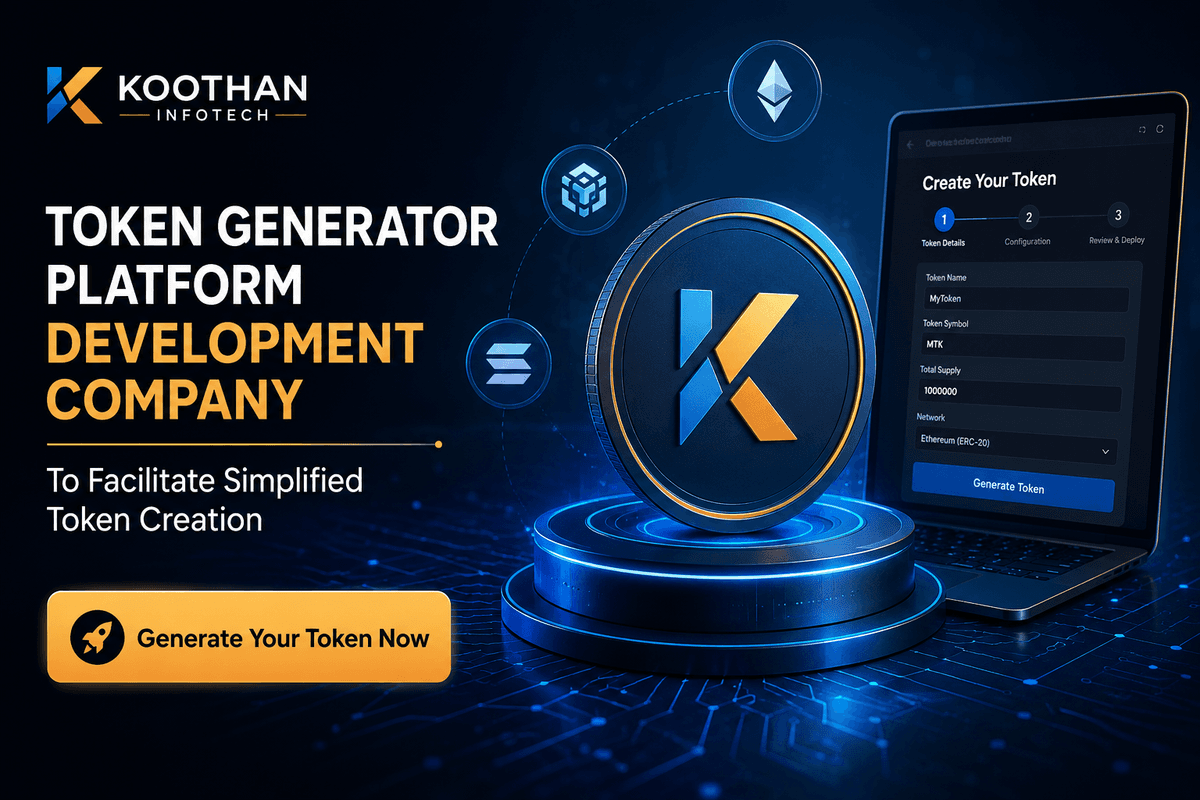
A token generator platform simplifies token creation through automated workflows and no-code interfaces, enabling businesses to launch custom blockchain tokens in minutes instead of weeks.
So, how do these platforms work, what features do they offer, and why are they becoming essential for modern Web3 businesses? Let's explore.
What is a Token Generator Platform?
A token generator platform is a software solution that enables users to create blockchain tokens using predefined templates and customizable configurations rather than manually writing smart contracts.
Instead of spending weeks developing Solidity contracts and deploying them manually, users simply enter parameters such as:
Token Name
Token Symbol
Total Supply
Decimal Precision
Minting Rights
Burning Mechanism
Tax Settings
Ownership Rules
Governance Permissions
The platform automatically generates and deploys the smart contract based on these inputs.
The result is a production-ready blockchain token deployed within minutes rather than weeks.
Why Do Businesses Need Token Generator Platforms?
The demand for blockchain tokenization is growing rapidly across industries.
Businesses are using tokens for:
Customer loyalty programs
Gaming ecosystems
DeFi applications
Community rewards
DAO governance
Real estate tokenization
Supply chain tracking
Crowdfunding campaigns
Digital collectibles
Creator economies
Despite growing interest, technical complexity remains one of the largest adoption barriers.
Token generator platforms solve this challenge by democratizing blockchain access.
Benefits include:
No coding knowledge required
Faster time to market
Lower development costs
Reduced smart contract risks
Simplified deployment process
Standardized token architecture
Easy customization
This accessibility is driving widespread adoption among startups and enterprises alike.
Token Generator Platform Development Company
A Token Generator Platform Development Company specializes in building custom token generation solutions that allow users to create blockchain tokens quickly, securely, and efficiently. These companies develop no-code or low-code token creation platforms with support for multiple blockchain networks, smart contract automation, wallet integration, token management dashboards, and advanced tokenomics features.
How Token Generator Platforms Work?
Modern token generator platforms simplify what was once a highly technical blockchain development process. Instead of writing complex smart contracts manually, users can create and deploy tokens through an intuitive workflow that takes only a few steps.
Step 1: Blockchain Selection
The process begins with selecting the blockchain network where the token will be deployed. Most token generator platforms support multiple blockchains to provide flexibility based on transaction costs, scalability, and ecosystem requirements.
Popular blockchain options include:
Ethereum
BNB Chain
Polygon
Base
Avalanche
Arbitrum
Optimism
Solana
Tron
Choosing the right blockchain plays a crucial role in determining transaction fees, network speed, liquidity opportunities, and compatibility with wallets and exchanges.
Step 2: Token Configuration
Once the blockchain is selected, users can configure the core attributes of their token through a simple dashboard. These settings define the token's identity and supply mechanics.
Common configuration options include:
Token Name
Token Symbol
Total Supply
Decimal Precision
Owner Wallet Address
This step allows businesses to customize their token according to their branding, business model, and tokenomics strategy without requiring any coding expertise.
Step 3: Advanced Feature Selection
Most modern token generator platforms provide optional features that enhance token functionality and security. Users can enable these features based on their project requirements.
Popular advanced features include:
Mintable Tokens
Burnable Tokens
Pausable Contracts
Blacklist Functionality
Whitelist Management
Reflection Rewards
Auto Liquidity Generation
Anti-Whale Protection
Transaction Tax Mechanisms
These capabilities help businesses create more sophisticated token ecosystems while maintaining flexibility for future growth and governance.
Step 4: Smart Contract Generation
After finalizing the token settings, the platform automatically generates the smart contract using pre-built and audited templates. This eliminates manual coding errors and significantly reduces development time.
The generated smart contract follows blockchain standards such as ERC20, BEP20, TRC20, or SPL depending on the selected network, ensuring compatibility across wallets, exchanges, and decentralized applications.
Step 5: Token Deployment
Once the smart contract is generated, users can connect their crypto wallet and deploy the token directly to the selected blockchain network. The deployment process requires only a small network transaction fee, commonly known as gas fees.
Within minutes, the token becomes live and operational on the blockchain, ready for transfers, integrations, and ecosystem usage.
Step 6: Smart Contract Verification
The final step involves verifying the deployed smart contract on blockchain explorers such as Etherscan, BscScan, or PolygonScan. Verification increases transparency by making the contract code publicly accessible and auditable.
A verified contract builds trust among investors, users, and exchanges while improving the credibility and legitimacy of the token project.
Types of Tokens Supported
Modern token generator platforms support a wide range of token types, enabling businesses to build customized blockchain ecosystems based on their specific goals and industry requirements.
Utility Tokens
Utility tokens are designed to provide users with access to products, services, or features within a particular ecosystem. Instead of representing ownership, these tokens function as digital access keys that power platform interactions and transactions.
Businesses commonly use utility tokens for subscription access, premium feature unlocks, marketplace payments, service fees, and customer reward programs. Since they encourage ecosystem participation, utility tokens have become one of the most widely adopted
token models in Web3 applications.
Governance Tokens
Governance tokens give token holders the ability to participate in decision-making processes within decentralized platforms and communities. Rather than relying on centralized management, projects can empower users to vote on proposals and influence the future direction of the ecosystem.
These tokens are widely used in Decentralized Autonomous Organizations (DAOs) for activities such as protocol upgrades, treasury management, voting on new features, and community proposals. Governance tokens promote transparency, community engagement, and decentralized control.
Security Tokens
Security tokens represent ownership or investment rights in real-world or financial assets and are often subject to regulatory compliance requirements. Unlike utility tokens, they function similarly to traditional financial instruments while leveraging blockchain technology for transparency and efficiency.
Common examples include tokenized equity shares, revenue-sharing models, investment funds, bonds, and fractional ownership opportunities. Security tokens are increasingly being used in industries such as real estate, private equity, and asset management.
Stablecoins
Stablecoins are blockchain tokens designed to maintain a stable value by being pegged to fiat currencies, commodities, or other assets. Their primary purpose is to reduce the price volatility commonly associated with cryptocurrencies.
Popular examples include USD-backed stablecoins, gold-backed tokens, and commodity-backed digital assets. Stablecoins are widely used for trading, payments, cross-border transactions, remittances, and decentralized finance applications due to their predictable value.
NFT Tokens
Non-Fungible Tokens (NFTs) represent unique digital assets that cannot be replaced or exchanged on a one-to-one basis like traditional cryptocurrencies. Each NFT contains distinct information that proves ownership and authenticity.
NFT tokens have transformed industries such as gaming, digital art, ticketing, real estate, sports collectibles, and fashion. Businesses increasingly use NFTs to create exclusive experiences, digital ownership models, and new revenue streams.
Loyalty Tokens
Loyalty tokens help businesses improve customer retention and engagement by rewarding users for specific actions or purchases. Unlike traditional points systems, blockchain-based loyalty programs provide greater transparency, interoperability, and transferability.
Companies use loyalty tokens for cashback rewards, membership programs, referral incentives, exclusive discounts, and customer engagement campaigns. As brands continue exploring Web3 strategies, loyalty tokens are becoming an important part of modern customer retention programs.
Supported Token Standards
Token standards define the rules and functionalities that govern how blockchain tokens operate and interact with wallets, exchanges, and decentralized applications. Token generator platforms typically support multiple standards to meet different business requirements.
ERC20 Token Development
ERC20 is the most widely adopted token standard on the Ethereum blockchain and serves as the foundation for thousands of cryptocurrencies and decentralized finance projects worldwide.
It is ideal for creating utility tokens, governance tokens, payment tokens, and DeFi assets due to its strong ecosystem support and compatibility with major wallets and exchanges. Businesses seeking maximum adoption and interoperability often choose ERC20 for their token projects.
BEP20 Token Development
BEP20 is the token standard used on BNB Chain and offers functionality similar to ERC20 while providing lower transaction costs and faster processing speeds.
Its affordability makes it particularly attractive for startups, community projects, gaming platforms, and meme coin ecosystems that require frequent transactions without high gas fees. BEP20 has become one of the most popular choices for new token launches.
TRC20 Token Development
TRC20 is the token standard built on the Tron blockchain and is known for its high transaction speed and extremely low fees. This makes it suitable for applications involving large transaction volumes.
TRC20 tokens are widely used in payment platforms, cryptocurrency exchanges, remittance solutions, and international fund transfers where cost efficiency is a major priority.
SPL Token Development
SPL is the standard token format used within the Solana ecosystem. Designed for high performance, SPL tokens benefit from Solana's ability to process thousands of transactions per second with minimal fees.
Projects focused on gaming, decentralized finance, NFT marketplaces, and high-frequency applications often choose SPL tokens due to their scalability and superior network throughput.
ERC721 Token Development
ERC721 is the most popular token standard for creating Non-Fungible Tokens on the Ethereum blockchain. Unlike fungible tokens, every ERC721 token is unique and carries individual ownership information.
This standard is widely used for digital art collections, gaming assets, event tickets, collectibles, virtual land, and intellectual property management.
ERC1155 Token Development
ERC1155 is a more advanced token standard that allows both fungible and non-fungible assets to exist within a single smart contract. This flexibility helps reduce deployment costs and improves operational efficiency.
It is particularly useful for blockchain games, metaverse applications, digital marketplaces, and platforms that need to manage multiple asset types under one ecosystem.
Unique Key Features of Our Token Generator Platform
No-Code Token Creation
Multi-Chain Compatibility
Customizable Token Standards
Smart Contract Auditing Built-In
Every single token
Real-Time Analytics Dashboard
Liquidity Pool Integration
White-Label Flexibility
Airdrop and Vesting Modules
Benefits Of Our Token Generator Platform Development Services
Faster Time to Market
Lower Development Costs
Recurring Revenue Model
Scalability Without Rebuilding
Stronger Security Posture
Cross-Industry Applicability
Full Ownership and Control
Why Choose Koothan Infotech To Build Your Own Token Generator Platform?
Koothan is a leading token development company that provides token development services with advanced security features.
We don't disappear once you go live.
Security from day one, not as an afterthought
No cookie-cutter builds
We've already hit the problems that blindside other teams.