Custom AI Model Development
Build a custom AI model designed around your business data, workflows, and specific operational requirements. Koothan Infotech develops AI models for prediction, classification, automation, recommendation, natural language processing, computer vision, and other business applications.
Get A Free Consultation
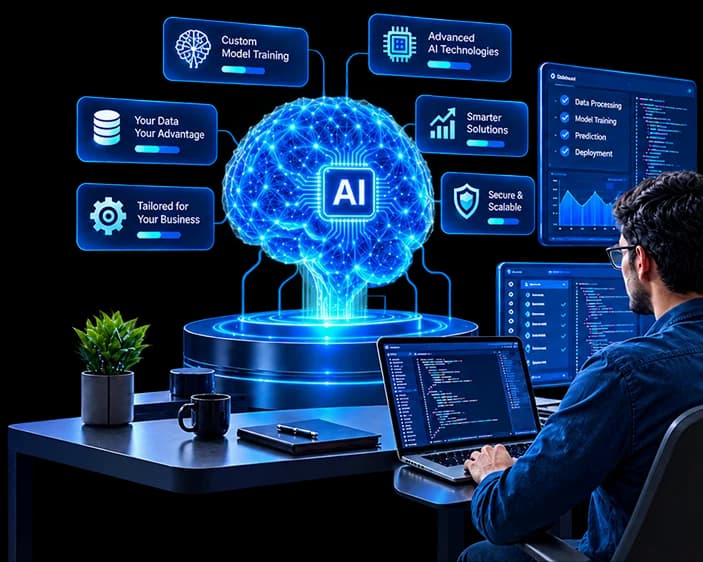
From Data to Decisions: Custom AI Model Development Company
Koothan Infotech provides custom AI model development services for businesses that need AI systems built around their own data, workflows, and business objectives. We develop machine learning and AI models for prediction, classification, recommendation, automation, document processing, computer vision, natural language processing, and intelligent decision support.
Our team works across the complete AI model development lifecycle from data preparation and model selection to training, evaluation, deployment, and ongoing optimization. Whether you need a predictive model for business forecasting or an AI solution integrated into an existing application, Koothan Infotech builds solutions aligned with your operational requirements.
Our team works across the complete AI model development lifecycle from data preparation and model selection to training, evaluation, deployment, and ongoing optimization. Whether you need a predictive model for business forecasting or an AI solution integrated into an existing application, Koothan Infotech builds solutions aligned with your operational requirements.
We Are a Top AI Development Services Provider
At Koothan Infotech, we build AI solutions that help businesses automate processes, analyze data, and create intelligent digit
100+
Skilled Professionals
25+
Global Clients
15+
Dedicated Development Teams
220+
Brands Scaling With Us
Our Custom AI Model Development Services
We build custom AI models based on your business data, industry requirements, and specific use cases.From model development and training to testing, deployment, and integration, we manage the complete AI development process.
01
AI Model Development
We build AI models for specific business needs using your data, workflows, and application requirements. From understanding the use case to training and deploying the model, we handle the complete development process.
02
Machine Learning Model Development
We develop machine learning models for prediction, classification, forecasting, pattern detection, and other business applications. The right approach is selected based on your data and the outcome you want from the model.
03
Generative AI Model Development
We develop Generative AI solutions for AI assistants, content generation, document analysis, knowledge search, summarization, and other business applications. We can connect AI models with your company data and existing systems.
04
Natural Language Processing
We build NLP solutions that help applications understand and work with text and language. These include chatbots, sentiment analysis, text classification, keyword and entity extraction, document processing, and intelligent search.
05
Computer Vision Development
We develop AI solutions that work with images and videos. Applications include object detection, image classification, OCR, quality inspection, face recognition, and visual data analysis.
06
Predictive AI Model Development
We develop models that use historical business data to identify patterns and make predictions. These solutions can be used for sales forecasting, demand prediction, customer behavior analysis, risk assessment, fraud detection, and other business requirements.
07
Recommendation Engine Development
We create recommendation systems that study customer activity, preferences, purchase history, and product information. These systems can recommend products, services, content, or other relevant options to users.
08
AI Model Training & Fine-Tuning
We prepare your datasets, train the selected AI model, test its results, and improve it based on the required output. For existing AI models, we can also fine-tune them with domain-specific data where appropriate.
09
AI Model Integration
We connect AI models with your existing websites, mobile apps, SaaS platforms, APIs, databases, and business software. This allows the AI functionality to work directly within your existing product or workflow.
10
AI Model Deployment
Once the model is ready, we deploy it in the required environment and configure the supporting infrastructure. We also consider response time, computing requirements, API access, security, and future maintenance.
Turn Your Data Into Intelligent AI Solutions
Build a custom AI model designed around your business needs, data, and goals. Partner with Koothan Infotech to develop, train, and deploy AI models for your business.
Benefits of Using Custom AI Model Development Services
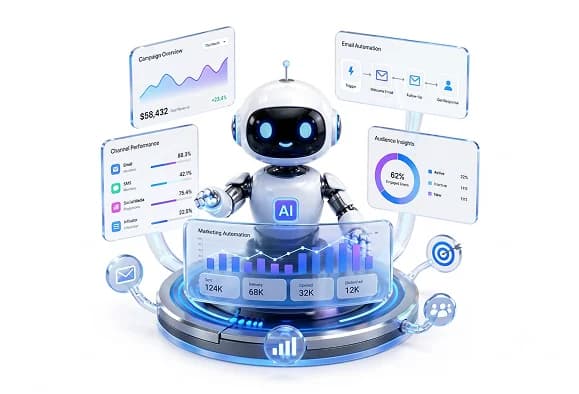
Businesses already have valuable information across customer records, sales data, transactions, documents, websites, applications, and internal systems. Custom AI models can be built around this information to solve a particular business problem instead of forcing the business to work with a general-purpose tool. This makes AI more relevant to the way your team actually works.
01
Built Around Your Business Requirements
A custom AI model starts with your business problem. The development team studies your workflow, available data, expected output, and application requirements before choosing the appropriate modeling approach. This allows the solution to focus on the task you actually want to improve.
02
Make Better Use of Existing Data
Most businesses collect large amounts of data but may not use all of it effectively. Custom models can process historical records, customer activity, transactions, documents, product information, and other datasets to find patterns that are useful for your business.
03
Automate Repetitive Work
AI models can take care of tasks that require repeated data processing or classification. For example, a business can use AI to categorize documents, identify customer queries, extract information, review images, or process large volumes of records.
04
Get Business-Specific Predictions
Instead of relying on general assumptions, a custom model can learn from data related to your business. Depending on the use case, it can help predict customer demand, sales trends, customer churn, fraud risks, equipment issues, or other measurable outcomes.
05
Improve Customer Experiences
AI models can use customer interactions, preferences, purchase history, and other relevant information to provide more suitable recommendations and responses. This can be applied to product recommendations, customer support, search, personalization, and customer segmentation.
06
Connect With Existing Systems
A custom AI model does not have to operate separately from your existing technology. It can be connected with websites, mobile applications, CRM systems, ERP platforms, databases, APIs, and other software so that AI-based functions become part of your existing workflow.
07
Support Faster Data Analysis
Processing large amounts of information manually can take considerable time. AI models can analyze relevant datasets and return structured results that help teams review information, identify patterns, and focus on business decisions rather than repetitive data handling.
08
Adapt to Changing Requirements
Business requirements and datasets change over time. A custom AI solution can be retrained or updated when new data becomes available, new features are required, or the business process changes.
09
Greater Control Over the Solution
With a custom model, businesses have more control over the data used, model functionality, application integration, and development approach. The solution can be designed according to the technical and operational requirements of the business.
How to Build a Custom AI Model?
Building a custom AI model starts with a clear business problem and the right data. The development process then moves through data preparation, model selection, training, testing, deployment, and ongoing improvement.
Define the Business Problem
Start by deciding what the AI model needs to solve. This could be predicting sales, detecting fraud, recommending products, classifying documents, analyzing customer feedback, or automating a specific business task.
Collect the Required Data
Identify the data needed to train the model. Depending on the project, this may include customer records, transaction data, documents, images, text, product information, website activity, or other business data.
Clean and Prepare the Data
Raw business data often contains missing values, duplicate records, incorrect entries, or inconsistent formats. The data is cleaned, organized, labeled when required, and prepared in a format suitable for model training.
Choose the Right AI Model
The model type depends on the problem and the available data. Machine learning, deep learning, NLP, computer vision, or Generative AI approaches may be used depending on the required outcome.
Train the Model
The prepared dataset is used to train the selected model. During training, the model learns patterns from the data and develops the ability to produce the required predictions, classifications, recommendations, or responses.
Test and Evaluate the Model
The trained model is tested using data that was not used during training. Its results are measured using suitable metrics such as accuracy, precision, recall, F1 score, or other business-specific measures.
Integrate and Deploy
Once the model meets the required performance level, it can be connected to your website, mobile application, software, API, or business platform. The deployment environment is selected based on the application's technical requirements.
Monitor and Improve
After deployment, the model needs to be monitored as new data and business requirements emerge. Performance can be reviewed regularly, and the model can be retrained or updated when improvements are needed.
What Could Your Data Do With the Right AI Model?
Your business already has the data now it’s time to put it to work. Talk to Koothan Infotech about building a custom AI model for your specific business needs.

Breaking Down the Challenges of AI Model Development
Building an AI model involves more than selecting a technology and training it. Businesses often face challenges with data quality, model selection, training costs, system integration, and maintaining model performance after deployment.
01
Top Tools and Frameworks to Build AI Models
The right AI tools and frameworks depend on the type of model, available data, development requirements, and deployment environment. Developers commonly combine programming languages, machine learning frameworks, data processing tools, and cloud platforms to build and deploy AI models.

PYTHON

TENSORFLOW

PYTORCH

SCIKIT-LEARN

HUGGING FACE

OPENAI APIS

LANGCHAIN

OPENCV

PANDAS

NUMPY

AWS

AZURE

GOOGLE CLOUD
How Koothan Infotech Can Help You Build Custom AI Models?
Koothan Infotech, a leading AI Development Company, helps businesses build custom AI models based on their data, business goals, and application requirements. We handle the complete process, from understanding the use case and preparing data to selecting the right AI approach, developing and training the model, testing results, and integrating it with your existing website, application, or business system. Our team works across machine learning, predictive AI, Generative AI, NLP, and computer vision to develop AI solutions for specific business needs.
 End-to-End AI Development
- Business-Focused AI Solutions
- Data-Driven Model Training
- Ongoing Model Support
People Ask For
What are digital banking solutions?
Digital banking solutions are technology platforms that allow banks and financial businesses to provide banking services through websites, mobile applications, and connected digital channels. They can support account management, fund transfers, payments, onboarding, lending, and financial insights.
What features can be included in a digital banking solution?
Can digital banking solutions integrate with payment gateways and financial APIs?
How secure are digital banking solutions?
What industries can use digital banking solutions?
How much does digital banking solution development cost?