


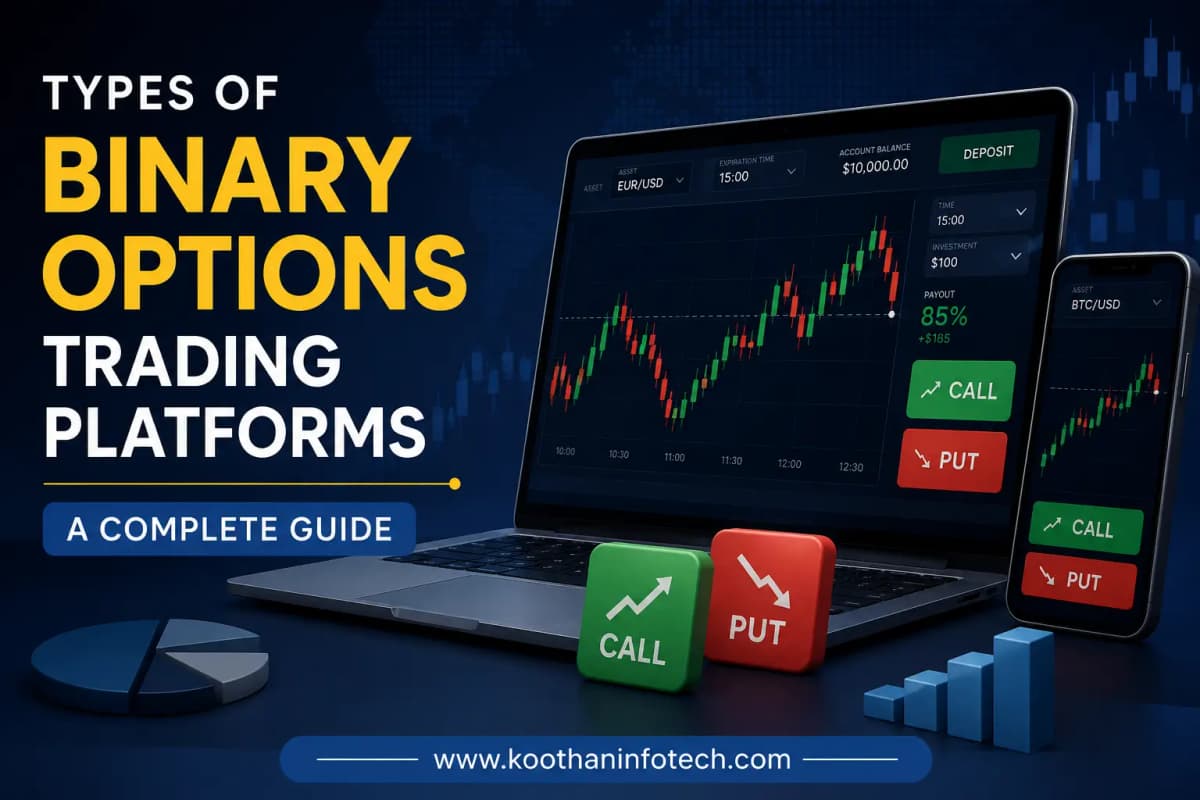
Thinking about launching a binary options trading platform but not sure where to begin? You're not alone. Most businesses entering the online trading space have a clear vision of the market they want to serve, but far less clarity on the technical models, features, and build process required to get there.
Getting the fundamentals right before development starts the trading model, the platform architecture, the feature set saves time, money, and a lot of rework later. This guide walks through what a binary options platform actually does, the trading formats you can offer, what the build process looks like, and what separates a platform that performs from one that struggles under real usage.
What Exactly Is a Binary Options Trading Platform?
At its core, a binary options platform lets a trader make a simple call: will an asset's price go up or down within a set window of time. There's no partial outcome the trade either pays out at a fixed rate or it doesn't.
From the trader's seat, the flow feels almost effortless: pick an asset, set an expiry window, choose a direction, confirm the trade, and wait for the result.
Behind that simplicity, though, a lot is happening. The platform has to stream live pricing continuously, log every trade with precision, manage user balances and accounts, calculate payouts instantly and correctly, and give administrators the tools to oversee everything happening on the system.
For a business, this isn't just an app it's the operational backbone of your entire trading service. That's why speed, security, and reliability aren't nice-to-haves here; they're the product.
The Main Types of Binary Options Trading
Not all binary trades follow the same logic. The model you choose shapes both the trader experience and what your platform needs to be built to support.
Cash-or-Nothing Options
The classic format. The trader picks a direction up or down before expiry. Guess right, and they get a fixed payout; guess wrong, and the trade simply closes with no return. It's the easiest model to understand, which makes it a natural starting point for both new and experienced traders.
One-Touch Options
Here, the trader bets that the asset will hit a specific price level at any point before expiry — it only needs to touch that level once to win. This format tends to appeal to traders anticipating sharp, decisive price swings.
No-Touch Options
The mirror image of One-Touch. The trader wins if the price never reaches the target level before the trade closes. This suits traders who expect a asset to stay range-bound or calm.
Boundary Options
Instead of a single target, the platform defines a price corridor an upper and lower bound. Traders wager on whether the price will stay inside that corridor or break out of it before expiry. It's a useful format for both stable markets and moments of expected volatility.
Deciding upfront which of these formats you'll support has a direct effect on your platform's logic, UI, and overall user journey so it's worth settling early in planning, not mid-build.
What Actually Goes Into Development Phases?
Building this kind of platform is far more involved than designing a clean interface. It requires the interface, the trading logic, live market data, account infrastructure, and security to all work together seamlessly.
The process typically unfolds in stages:
Discovery and planning - Defining your target audience, the trading types you'll support, and your core feature list.
Interface design - Creating a trading experience that feels intuitive even to first-time users.
Core build - Developing the trading engine, wallet and payments system, admin dashboard, user account management, reporting tools, and real-time market data feeds.
Testing - Validating that trades execute correctly, payouts calculate accurately, and the system holds up under heavy concurrent load.
Launch and ongoing maintenance - Ongoing updates, monitoring, and feature additions as the platform matures.
Key Features Worth Building In Binary Trading Option Platform
Beyond the core trading engine, a handful of features tend to separate a platform users trust from one they abandon:
Real-time price feeds from reliable market data providers, with minimal latency
A secure digital wallet supporting deposits, withdrawals, and multiple payment methods
KYC and identity verification to meet compliance requirements in your target markets
An admin dashboard for monitoring trades, managing users, and adjusting platform settings
Detailed trade history and reporting so users can track their own performance
Risk and exposure controls that let you manage payout ratios and platform-side risk
Multi-device responsiveness, since a meaningful share of trading activity happens on mobile
Notifications and alerts for trade expiry, account activity, and price movement
Which of these matter most depends heavily on your target market and regulatory environment worth discussing with your development partner before locking in scope.
Why Build Quality Isn't Optional Here?
Development quality shows up immediately in how the platform performs. A well-built system responds fast, executes trades accurately, and stays stable when things get busy.
Cut corners during the build, and the consequences surface exactly when you can least afford them laggy execution, miscalculated payouts, or outages during high-traffic periods.
Getting the architecture right from day one also pays off later: it's far easier to scale a platform that was built with growth in mind than to retrofit one that wasn't.
A Note on Regulation
Binary options trading is tightly regulated and outright restricted or banned in a number of jurisdictions, and rules vary significantly by country and even by asset class. Anyone building or operating a platform in this space should work with legal counsel to understand licensing requirements, permitted markets, and compliance obligations before launch. This is a fast-moving regulatory area, so what's permitted today may not remain so, and vice versa.
Why Koothan Infotech Fits In Binary Trading Option Platform Development?
Building a trading platform takes more than technical skill it takes an understanding of how trading actually works and what users expect from the experience.
At Koothan Infotech, we build custom binary options platforms shaped around each client's specific business model rather than working off a generic template. We start by understanding your goals, help you choose the right trading formats to support, and build out a platform from real-time data integration to secure wallets to admin controls that's ready for real trading volume.
Every build goes through rigorous testing before launch, and our involvement doesn't end at deployment we stay on for ongoing support, updates, and feature development as your platform grows.
Final Thoughts
A strong binary options trading platform starts with a clear understanding of how the trading models work and which ones fit your audience. Combine that with careful planning, sound architecture, and an experienced development partner, and you end up with a platform built to perform not just launch.
If you're ready to plan, build, and scale a custom binary options trading platform, Koothan Infotech can help you take it from concept to launch and beyond.