


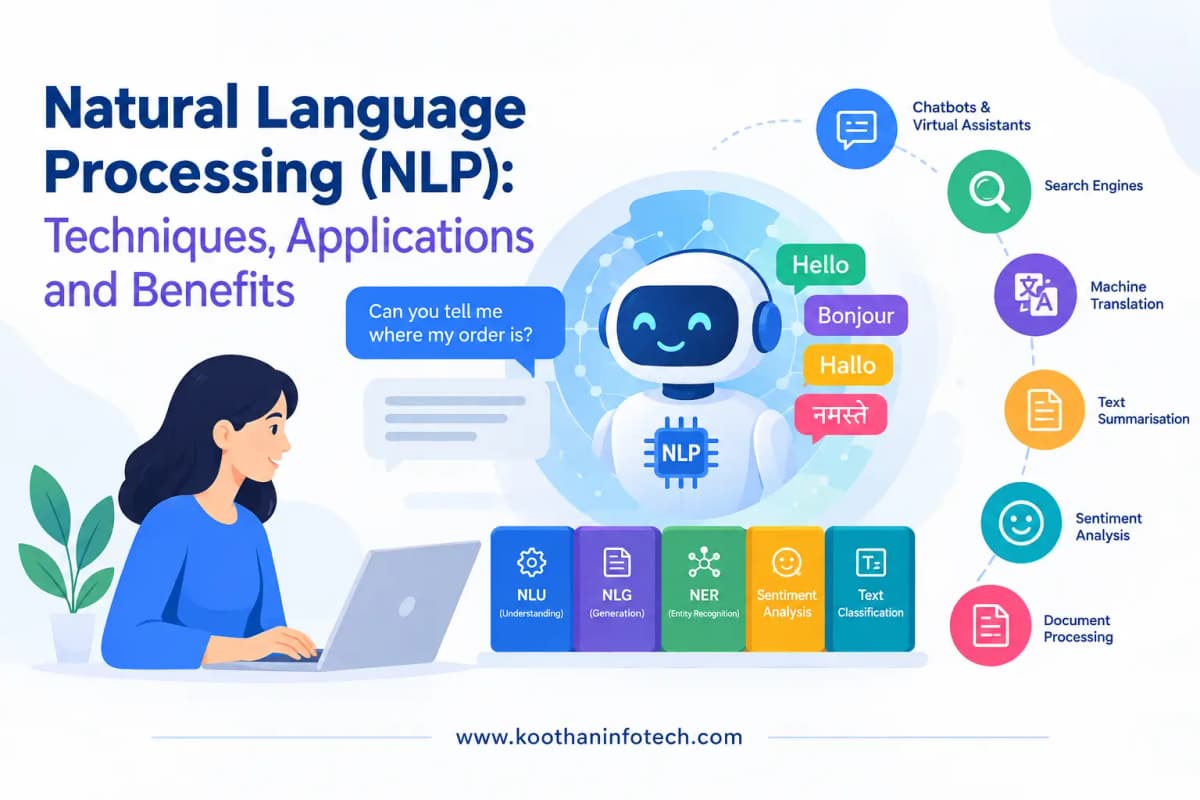
Human communication involves words, sentences, questions, and conversations. People use different languages and expressions to share information, but computers require specific methods to process and interpret this communication. Natural Language Processing (NLP) helps bridge this gap by enabling computer systems to understand, analyse, and generate human language.
Today, Natural Language Processing is used in search engines, chatbots, voice assistants, translation applications, customer support platforms, and business software. It helps applications analyse written and spoken information, identify user intent, extract important details, and provide relevant responses.
As a branch of Artificial Intelligence (AI), NLP combines computational linguistics, machine learning, and deep learning to process human language. Understanding its techniques, applications, and benefits helps businesses identify opportunities to use language-based technologies in their software applications.
What Is Natural Language Processing (NLP)?
Natural Language Processing (NLP) is a branch of Artificial Intelligence that enables computers to read, understand, interpret, and generate human language. It allows software applications to process written text and spoken communication rather than depending entirely on structured data or predefined commands.
NLP combines computer science and linguistics to analyse the structure, meaning, and context of language. It uses different methods to identify words, understand sentence relationships, recognise user intent, and extract useful information from written or spoken communication.
For example, consider a customer asking an online shopping chatbot, "Can you tell me where my order is?"
An NLP-based application can process this question, identify the customer's intention, recognise that the request relates to order tracking, and retrieve the relevant information from the connected system.
Natural Language Processing is used in several areas:
AI chatbots and virtual assistants
Search engine query processing
Voice recognition applications
Language translation software
Customer sentiment analysis
Text summarisation
Email filtering and spam detection
Automated document processing
Information extraction
These applications help businesses process large amounts of language-based information and manage customer communication.
How Does Natural Language Processing Work?
Natural Language Processing involves multiple stages that convert written or spoken language into information that a computer can process. The exact workflow depends on the application, dataset, and NLP model being used.
1. Text and Speech Data Collection
The process begins with collecting language data from different sources. These sources may include websites, customer conversations, product reviews, business documents, emails, support tickets, and recorded speech.
The collected information provides the data required to train or operate an NLP system.
2. Text Preprocessing
Text preprocessing prepares the collected information for analysis. It involves cleaning unnecessary characters, handling punctuation, standardising text, and removing irrelevant information where appropriate.
Common text preprocessing methods include:
Lowercase conversion
Removing unnecessary symbols
Stop-word removal
Stemming
Lemmatization
Tokenisation
The preprocessing requirements depend on the language, dataset, and purpose of the application.
3. Tokenisation
Tokenisation divides a sentence into smaller units called tokens. These units can be individual words, subwords, or characters.
For example:
Input: Natural Language Processing helps computers understand text.
Tokens: Natural, Language, Processing, helps, computers, understand, text.
Tokenisation allows NLP systems to examine individual language components and their relationships.
4. Syntactic Analysis
Syntactic analysis examines the grammatical structure of a sentence. It identifies how words relate to one another and how they form meaningful phrases.
Part-of-speech tagging and dependency parsing are commonly used techniques.
For example, an NLP system can identify nouns, verbs, adjectives, and other grammatical elements in a sentence.
5. Semantic Analysis
Semantic analysis focuses on the meaning of words and sentences. It helps computer systems distinguish between different meanings based on the surrounding context.
For example, the word "bank" may refer to a financial institution or the side of a river. Semantic analysis uses the context to identify the intended meaning.
6. Model Training and Processing
Machine learning and deep learning models process language patterns using training datasets. Depending on the application, NLP systems may use statistical methods, neural networks, transformer architectures, or pre-trained language models.
These models learn relationships between words and language structures to perform specific tasks.
7. Output Generation
After processing the input, the system produces an output based on the application's purpose.
The result may include a chatbot response, translated sentence, document summary, sentiment classification, or extracted information.
Major Techniques Used in Natural Language Processing
NLP uses different techniques to understand, classify, and generate human language. Each technique performs a particular function within a language processing system.
1. Natural Language Understanding (NLU)
Natural Language Understanding is a part of NLP that focuses on identifying the meaning and intention behind human communication.
NLU helps applications understand user questions, recognise entities, identify intent, and interpret sentence context.
For example, when a customer asks, "I want to change my delivery address," an NLU system can identify the request as an address modification.
2. Natural Language Generation (NLG)
Natural Language Generation converts structured information into readable human language.
It is used in chatbot responses, automated reports, product descriptions, summaries, and conversational applications.
For example, a business application can convert sales figures into a short written performance report using NLG.
3. Named Entity Recognition (NER)
Named Entity Recognition identifies important entities mentioned in a sentence or document.
Common entity categories include:
Person names
Company names
Locations
Dates
Organisations
Monetary values
Product names
For example, in the sentence "Koothan Infotech provides AI development services in India," an NER system can identify Koothan Infotech as an organisation and India as a location.
4. Sentiment Analysis
Sentiment analysis identifies the emotional tone or opinion expressed in text.
It commonly classifies information into positive, negative, or neutral categories.
Businesses use sentiment analysis to study customer reviews, feedback forms, social media comments, and product ratings.
5. Text Classification
Text classification assigns predefined categories to written content based on its meaning.
For example, an email management application can classify incoming messages as sales enquiries, customer complaints, payment requests, or general enquiries.
6. Machine Translation
Machine translation converts written content from one language into another.
Applications such as Google Translate use advanced language processing and neural machine translation techniques to interpret and translate text.
7. Speech Recognition
Speech recognition converts spoken language into written text. It is commonly used in voice assistants, transcription applications, voice search, and automated customer service systems.
8. Text Summarisation
Text summarisation reduces lengthy documents into shorter versions while retaining the main information.
It is useful for research documents, business reports, news articles, meeting transcripts, and customer feedback analysis.
Types of Natural Language Processing
Natural Language Processing methods can be classified according to how systems analyse language and perform specific tasks.
Rule-Based NLP
Rule-based NLP uses predefined grammatical rules, dictionaries, and patterns to process text. Developers define the conditions that determine how the system should interpret particular language structures.
For example, a basic customer support application may use keyword patterns to identify common questions and provide predefined responses.
Statistical NLP
Statistical NLP uses mathematical models and probability-based methods to identify language patterns.
It analyses text datasets to estimate the likelihood of words, phrases, and sentence structures. Statistical methods have been widely used in language modelling, speech recognition, and machine translation.
Machine Learning-Based NLP
Machine learning-based NLP uses algorithms trained on language datasets to perform tasks such as text classification, spam detection, and sentiment analysis.
Instead of relying entirely on manually written rules, these systems learn patterns from examples.
Common machine learning algorithms include:
Naive Bayes
Support Vector Machines (SVM)
Decision Trees
Random Forest
Logistic Regression
Deep Learning-Based NLP
Deep learning-based NLP uses artificial neural networks to identify complex language patterns.
Common architectures include Recurrent Neural Networks (RNNs), Long Short-Term Memory networks (LSTMs), and transformer models.
Transformer-based models are widely used in modern language applications because they can analyse relationships between words across longer text sequences.
Real-World Applications of Natural Language Processing
Natural Language Processing has applications across industries where businesses need to understand, organise, and process written or spoken information.
1. AI Chatbots and Customer Support
Businesses use NLP-powered chatbots to respond to customer questions, provide product information, check order details, and handle common service requests.
These applications identify the intention behind customer messages and provide responses based on available information.
For example, an online shopping platform can use a chatbot to answer questions about product availability, delivery status, and return policies.
2. Search Engines and Information Retrieval
Search engines use language processing techniques to understand search queries and identify relevant information.
NLP helps interpret the meaning of search terms, relationships between words, and the context of user questions.
For example, when someone searches for "best software for managing business accounts," the search system needs to understand the topic and identify relevant pages rather than simply match individual words.
3. Healthcare and Medical Documentation
Healthcare organisations can use NLP to process medical documents, analyse clinical notes, organise patient information, and extract relevant details from unstructured text.
For example, NLP applications can identify medical terms, medication names, and clinical information from healthcare documentation.
Such applications must follow applicable data protection and healthcare regulations.
4. Banking and Financial Services
Financial institutions use NLP to analyse customer enquiries, process financial documents, categorise support requests, and examine customer feedback.
It can also assist with document analysis and information extraction from financial reports.
5. E-Commerce and Retail
Online retail businesses receive large amounts of customer reviews, product enquiries, and support messages.
NLP helps categorise customer feedback, identify product-related complaints, analyse reviews, and improve product search experiences.
6. Education and E-Learning
Educational platforms use NLP for automated question answering, language learning applications, text correction, and document summarisation.
It can also assist students in understanding written material and help educators organise learning resources.
7. Human Resources and Recruitment
HR departments can use NLP to extract information from resumes, categorise job applications, identify relevant skills, and organise recruitment documents.
For example, a recruitment application can identify qualifications, work experience, and technical skills from candidate resumes. Such systems should be reviewed for accuracy and potential hiring bias.
8. Social Media Monitoring
Businesses analyse social media comments, mentions, and customer discussions to understand public opinions about their products and services.
Sentiment analysis and text classification help organise large volumes of social media information into meaningful categories.
Benefits of Natural Language Processing for Businesses
NLP can support business operations by reducing manual language-related work and improving access to information.
1. Improved Customer Communication
NLP-powered chatbots can handle common customer questions and provide information through conversational interfaces.
2. Faster Information Processing
Applications can extract relevant details from large volumes of documents, emails, and messages.
3. Better Customer Feedback Analysis
Sentiment analysis helps businesses identify customer opinions, recurring complaints, and common feedback patterns.
4. Improved Search Experience
Language understanding helps users find information through natural language queries instead of relying only on exact keyword matches.
5. Multilingual Communication
Machine translation supports communication across different languages and geographical markets.
6. Automated Document Management
NLP can classify documents, identify important information, and reduce manual document handling.
7. Useful Business Insights
Text analysis helps organisations identify patterns in customer conversations, product reviews, and support requests.
Difference Between NLP, NLU, NLG, and LLM
NLP, NLU, NLG, and Large Language Models are related concepts in Artificial Intelligence, but each has a different role.
Technology
NLP
Natural Language Processing - Processes human language
NLU
Natural Language Understanding - Identifies meaning and intent
NLG
Natural Language Generation - Produces human-readable text
LLM
Large Language Model - Processes and generates language using large-scale model training
For example, when a user asks a chatbot about a product, NLP processes the input, NLU identifies the request, and an appropriate language generation component produces the response. An LLM may perform several of these language tasks within the same application.
Challenges in Natural Language Processing
Although NLP has many applications, processing human language involves several technical challenges.
Language Ambiguity
Words and phrases can have different meanings depending on the context. Identifying the correct meaning requires an understanding of surrounding information.
Regional Languages and Dialects
Different languages, dialects, spelling variations, and regional expressions can affect the accuracy of language processing systems.
Context Understanding
Sarcasm, humour, indirect communication, and cultural references can be difficult for NLP systems to interpret correctly.
Data Quality
Incomplete, inaccurate, or biased training data can affect the performance of NLP models.
Data Privacy and Security
Applications that process customer messages, personal information, and confidential documents must follow suitable privacy and security practices.
Computational Requirements
Training and operating advanced language models may require substantial computing resources, depending on model size and application requirements.
How to Choose the Right NLP Development Approach?
Choosing an appropriate NLP approach depends on the type of information being processed and the intended business application.
Before starting development, businesses should consider the following factors:
1. Identify Business Requirements
Determine whether the application needs chatbot functionality, sentiment analysis, document processing, text classification, or language translation.
2. Examine Available Data
Evaluate the quantity, quality, language, and format of the available data. The dataset should match the intended application.
3. Select Suitable NLP Models
Choose between rule-based methods, machine learning algorithms, deep learning architectures, and pre-trained language models based on the technical requirements.
4. Consider Language Requirements
Identify the languages, regional variations, and industry-specific terminology that the application needs to process.
5. Plan Application Integration
Determine how the NLP solution will connect with existing websites, mobile applications, CRM platforms, or enterprise software.
6. Test and Evaluate Performance
Measure accuracy, response quality, processing time, and overall performance using relevant test data.
A clearly defined requirement helps businesses select suitable technologies and plan the development process.
Natural Language Processing Development Services by Koothan Infotech
Koothan Infotech provides Natural Language Processing development services for businesses looking to integrate language processing capabilities into their software applications. As an AI Development Company, Koothan Infotech works with AI technologies to support applications involving text analysis, language understanding, and automated communication.
Our NLP development services cover different business requirements, including:
NLP-powered chatbot development
Natural Language Understanding (NLU)
Sentiment analysis applications
Text classification systems
Named Entity Recognition (NER)
Automated document processing
Language translation applications
AI-based text analysis
Each project begins with an understanding of the application requirements, available datasets, language requirements, and expected functionality. Based on these factors, suitable NLP techniques and machine learning models can be selected.
Businesses can integrate language processing capabilities into websites, mobile applications, customer support platforms, and enterprise software.
To discuss your requirements, contact Koothan Infotech and explore our AI Development Services.
Conclusion
Natural Language Processing has become an important technology within Artificial Intelligence. It allows computer systems to process written and spoken communication, identify language patterns, understand user intent, and generate meaningful responses.
From chatbots and search engines to healthcare documentation, financial services, and automated document processing, NLP has practical applications across multiple industries.
Understanding NLP techniques, machine learning methods, language models, and real-world applications helps businesses identify suitable opportunities for development.
As language technologies continue to advance, Natural Language Processing will remain an important part of software applications that work with human communication. Businesses planning to introduce language-based features into their software can explore NLP development based on their data, application requirements, and intended use cases.