


Artificial Intelligence (AI) is now part of many activities we perform every day. From searching for information and writing emails to editing images, translating languages, and managing business tasks, AI software applications help people handle different types of work. These applications use technologies such as Machine Learning (ML), Natural Language Processing (NLP), Deep Learning, and Generative AI to process information and respond to user instructions.
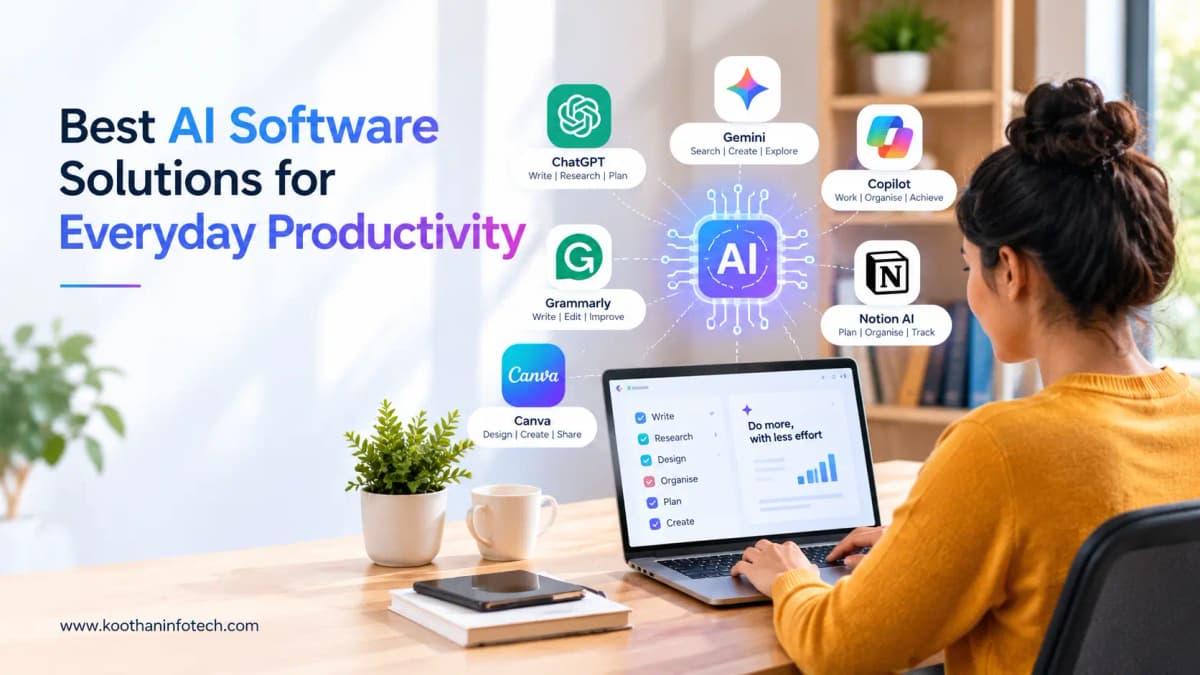
Today, AI-powered software is used by students, employees, business owners, developers, marketers, designers, and researchers. Applications such as ChatGPT, Google Gemini, Microsoft Copilot, Grammarly, and Canva provide features for different personal and professional requirements.
Understanding these applications helps individuals select suitable tools for their daily activities and businesses identify opportunities to develop AI-powered applications.
What Are AI Software Solutions?
AI software solutions are computer programs and applications that use Artificial Intelligence technologies to perform tasks that normally require human intelligence. These tasks include understanding language, recognising images, analysing information, generating content, identifying patterns, and responding to questions.
Most AI applications combine different technologies depending on their purpose. For example, chatbots use Natural Language Processing to understand user messages, while recommendation systems analyse user activity to suggest relevant products or content.
Common categories of AI software include:
- Generative AI Software: Creates text, images, presentations, and other digital content.
- AI Chatbots: Responds to customer questions and user instructions.
- Machine Learning Software: Analyses data and identifies patterns.
- Natural Language Processing Tools: Processes, translates, and understands human language.
- AI Image Generation Tools: Creates or edits images based on text instructions.
- AI Productivity Software: Assists with writing, documentation, scheduling, and workplace activities.
- AI Automation Software: Automates selected repetitive business processes.
10 AI Software Solutions We Use in Our Daily Lives
1. ChatGPT – AI Chatbot for Writing and Research
ChatGPT is a conversational AI application developed by OpenAI. It uses Large Language Models (LLMs) to understand user instructions and generate responses in natural language.
People use ChatGPT for content writing, email drafting, research, programming assistance, learning, and everyday problem-solving.
Common uses:
- Preparing emails, reports, and business documents.
- Generating blog outlines and social media content.
- Explaining technical and educational topics.
- Writing and reviewing programming code.
- Summarising documents and organising information.
- Preparing interview questions and study materials.
For example, a digital marketing professional can use ChatGPT to prepare a blog outline, generate content ideas, and develop an initial social media calendar.
2. Google Gemini – AI Assistant for Information and Content
Google Gemini is an AI assistant that supports research, content generation, information processing, and productivity tasks. It uses Google's AI models to understand prompts and work with supported information formats.
It is useful for students, professionals, and business owners who need assistance with everyday information-related activities.
Common uses:
- Researching educational and business topics.
- Creating content outlines and summaries.
- Understanding complex technical subjects.
- Generating ideas for presentations.
- Analysing supported documents and information.
- Assisting with planning and brainstorming.
For example, students can use Gemini to understand programming concepts, prepare study notes, and explore additional explanations for difficult subjects.
3. Grammarly – AI Writing and Grammar Checker
Grammarly is a writing assistance platform that helps users review grammar, spelling, punctuation, sentence clarity, and communication tone.
It is widely used for professional emails, website content, academic assignments, reports, and business communication.
Common uses:
- Checking spelling and grammatical errors.
- Improving sentence structure.
- Reviewing professional email communication.
- Identifying unclear sentences.
- Adjusting writing tone.
- Reviewing website and marketing content.
For example, an employee preparing a client proposal can use Grammarly to review the document before sharing it with the customer.
4. Canva AI – AI Graphic Design Software
Canva is an online graphic design platform that includes AI-powered design and content creation features. It helps users create visual materials without requiring advanced graphic design knowledge.
Its AI capabilities support image generation, background editing, design assistance, and content creation.
Common uses:
- Creating social media posts and advertisements.
- Designing business presentations.
- Preparing promotional banners and posters.
- Editing photographs and backgrounds.
- Developing marketing materials.
- Creating visual content for websites.
For example, a small business can create Instagram promotional designs, product announcements, and advertising creatives using Canva templates and its AI features.
5. Microsoft Copilot – AI Assistant for Office Productivity
Microsoft Copilot provides AI assistance across supported Microsoft products and services. It helps users work with documents, spreadsheets, presentations, and other workplace information.
Its features depend on the Microsoft application, subscription, and available integrations.
Common uses:
- Preparing documents in Microsoft Word.
- Analysing spreadsheet information in Excel.
- Creating presentation outlines in PowerPoint.
- Summarising information.
- Drafting workplace communication.
- Supporting business productivity tasks.
For example, an accounts or sales team can use supported Copilot features to examine spreadsheet data and prepare summaries for internal reporting.
6. Google Assistant – AI-Based Voice Assistant
Google Assistant is a voice-based digital assistant that helps users interact with compatible devices through spoken commands. It supports common activities such as reminders, alarms, searches, and smart home controls.
Common uses:
- Setting alarms and reminders.
- Checking weather information.
- Searching for general information.
- Managing compatible smart home devices.
- Playing music and controlling media.
- Accessing supported device functions through voice commands.
For example, someone preparing food can set a timer or check the weather using a voice command without manually navigating through different applications.
7. DeepL – AI Language Translation Software
DeepL is an AI-powered translation platform that helps users translate written content between supported languages. It is useful for businesses, students, international teams, and people communicating across language groups.
Common uses:
- Translating business documents.
- Understanding foreign-language articles.
- Preparing multilingual communication.
- Translating emails and written messages.
- Supporting international business communication.
- Reviewing translated text.
For example, a business communicating with an overseas customer can use DeepL to understand incoming messages and prepare an initial response in the customer's language.
8. Notion AI – AI Knowledge and Project Management
Notion combines document management, note-taking, task management, and project organisation. Its AI features assist users with summarising information, drafting content, and organising workplace knowledge.
Common uses:
- Maintaining meeting notes.
- Preparing project documentation.
- Organising tasks and deadlines.
- Summarising written information.
- Creating content drafts.
- Managing team knowledge bases.
For example, a project manager can organise meeting discussions, record responsibilities, and maintain project updates in a shared workspace.
9. Adobe Firefly – Generative AI Image Software
Adobe Firefly is a generative AI platform designed for creative work. It offers image generation and editing features that allow users to create visual content using text descriptions and supported editing tools.
Common uses:
- Generating images from text prompts.
- Editing image backgrounds.
- Creating marketing visuals.
- Exploring creative design concepts.
- Modifying visual assets.
- Supporting advertising and graphic design work.
For example, a graphic designer can generate an initial promotional image using a text prompt and refine the result for a marketing campaign.
10. Perplexity AI – AI Search and Research Platform
Perplexity AI is an AI-powered search and answer platform that helps users explore information and identify supporting sources. It combines conversational responses with source references for further reading.
Common uses:
- Researching industry-related topics.
- Finding supporting articles and references.
- Exploring technical information.
- Comparing information from different sources.
- Preparing initial research summaries.
- Discovering resources for academic projects.
For example, a business analyst can research industry developments, identify relevant reports, and examine source material before preparing a business document.
How AI Technologies Work Behind These Software Applications?
Different AI technologies contribute to the functions available in everyday applications. Understanding these technologies helps explain how AI software processes user instructions and produces results.
Artificial Intelligence (AI)
Artificial Intelligence is the broader field of computer science focused on developing systems that perform tasks associated with human intelligence. It includes language processing, image recognition, reasoning, prediction, and automated decision-making.
Machine Learning (ML)
Machine Learning enables software to identify patterns in data and improve its performance through training. It is commonly used in recommendation engines, spam detection, fraud identification, and predictive analytics.
Natural Language Processing (NLP)
Natural Language Processing enables computers to process and understand human language. It supports chatbots, language translation, sentiment analysis, voice-based applications, and text classification.
Deep Learning
Deep Learning uses multi-layered neural networks to process complex data. It is applied in image recognition, speech processing, language models, and computer vision applications.
Generative AI
Generative AI produces new content based on learned patterns and user instructions. It supports text generation, image creation, code assistance, audio generation, and other creative applications.
Large Language Models (LLMs)
Large Language Models are trained on extensive text datasets to understand and generate language. They are used in conversational AI applications, content assistance, document processing, and question-answering systems.
Benefits of Using AI Software in Everyday Life
AI software offers several practical benefits for individuals and organisations.
1. Time Management: AI writing assistants, reminders, and document summarisation features help reduce time spent on selected routine activities.
2. Better Communication: Translation platforms, grammar checkers, and conversational assistants support written and spoken communication.
3. Learning Support: AI applications help students explore subjects, understand technical concepts, and prepare study materials.
4. Content Creation: Generative AI tools assist with blog writing, image generation, presentations, and marketing content.
5. Business Productivity: AI applications support customer communication, document processing, reporting, and selected workflow automation tasks.
6. Information Analysis: Machine Learning and data analysis features help users identify patterns and understand large datasets.
How Businesses Can Use AI Software Solutions?
AI applications are not limited to personal productivity. Businesses across industries use Artificial Intelligence to handle different operational requirements.
- Healthcare: Medical documentation support, appointment assistance, and healthcare information processing.
- E-commerce: Product recommendations, customer support chatbots, and shopping assistance.
- Banking and Finance: Transaction monitoring, fraud detection, and customer enquiry management.
- Education: Learning assistants, educational content preparation, and automated assessment support.
- Real Estate: Property search assistance, customer enquiry handling, and document processing.
- Digital Marketing: Content assistance, customer segmentation, campaign analysis, and sentiment analysis.
- Customer Service: Conversational chatbots, enquiry classification, and automated ticket routing.
Businesses can use existing AI platforms or develop applications that address their own operational requirements.
Things to Consider Before Choosing AI Software
Before selecting an AI application, individuals and businesses should evaluate its features, pricing, security, and suitability.
- Data Privacy: Review how the application collects, processes, and stores user information.
- Accuracy: Verify generated answers, calculations, and research information before using them.
- Security: Check available access controls, encryption, and data protection arrangements.
- Integration: Understand whether the software works with existing business applications and systems.
- Pricing: Compare free plans, subscription costs, usage limits, and premium features.
- Licensing: Review commercial usage rights for generated text, images, and other content.
- Human Review: Keep people involved in important decisions and verify automated outputs.
Conclusion
AI software solutions are used in everyday activities such as writing, research, translation, graphic design, communication, and business management. Applications such as ChatGPT, Google Gemini, Grammarly, Canva, Microsoft Copilot, and Perplexity demonstrate how different AI technologies support personal and professional tasks.
The right application depends on the user's requirements, available features, budget, and information security needs. Businesses looking for more specialised capabilities can also explore custom AI applications, intelligent chatbots, machine learning systems, and automated document processing.
Koothan Infotech is an AI Development company that works on AI software solutions based on business requirements, application needs, and technical specifications. Understanding existing AI applications is a useful starting point for businesses planning their own Artificial Intelligence software.