


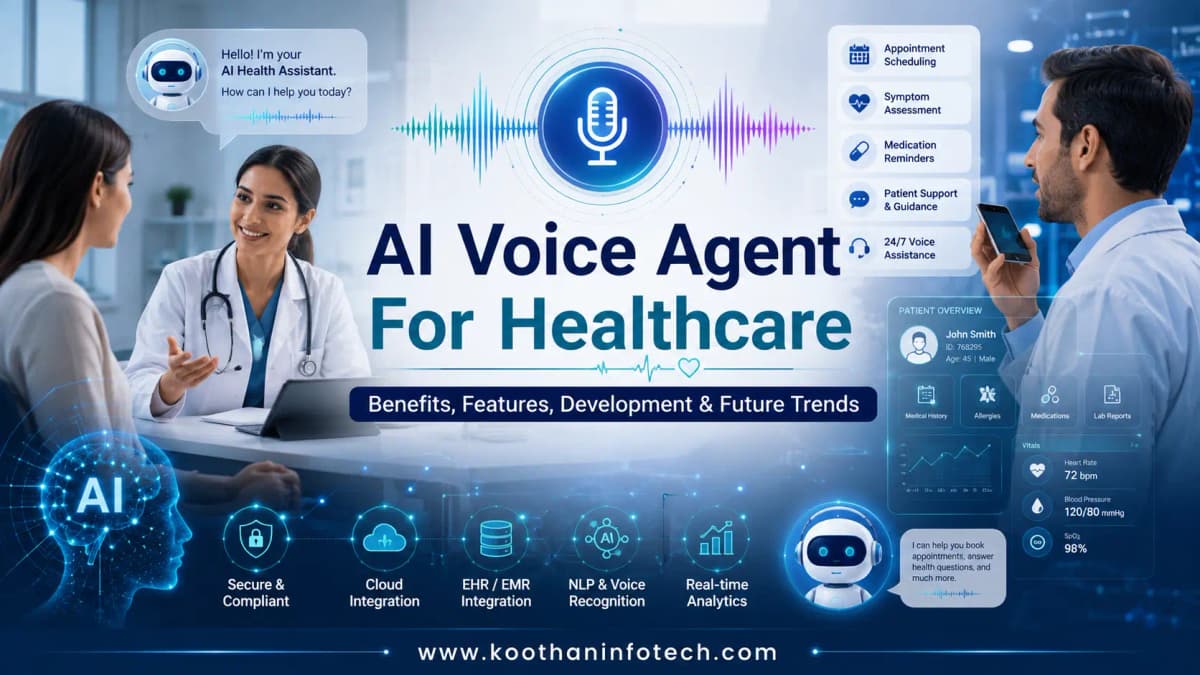
Patients calling a clinic to book an appointment, check a test result, or ask a quick medical question shouldn't have to sit on hold for twenty minutes. That's the everyday problem AI voice agents are starting to solve in hospitals, clinics, diagnostic labs, and telemedicine platforms.
This isn't about replacing doctors or nurses. It's about taking the repetitive phone work off their plate so they can spend more time actually treating people.
What Is an AI Voice Agent, Really?
An AI voice agent is software that can hold a spoken conversation with a patient understand what they're asking, figure out what to do about it, and respond in natural language. It relies on a mix of speech recognition, natural language processing, and machine learning to make the interaction feel less like talking to a phone menu and more like talking to a person.
In practice, it can handle things like scheduling an appointment, confirming a prescription refill, answering an insurance question, or walking a patient through basic symptom triage all without a human picking up the phone.
AI Voice Agents for Healthcare
Healthcare is a bit different from other industries when it comes to voice AI. A retail bot can afford to get an answer slightly wrong a healthcare one can't. That's why voice agents built for this space are designed around a few non-negotiables: accuracy, patient privacy, and the ability to hand off to a human the moment something falls outside their depth.
At their core, these agents sit between the patient and the healthcare organization's existing systems EHR platforms, scheduling software, billing systems, telemedicine tools and act as a conversational layer on top of all of it. The patient just talks. The system figures out which backend process needs to run.
This is different from a generic chatbot in a few important ways:
Built for regulated data
Every interaction involving patient information has to meet HIPAA requirements, not just general data protection standards.
Designed for escalation, not just automation
A healthcare voice agent's job isn't to answer everything it's to know exactly when not to answer and pass the call to a nurse or doctor instead.
Trained on medical context
Symptoms, medication names, and clinical terminology need to be understood correctly, not approximated.
Integrated deeply, not bolted on
It needs live access to appointment calendars, patient records, and provider availability to actually be useful a voice bot that can't check real data is just a fancier IVR system.
How These Systems Actually Work?
It helps to break the process down into steps:
1. The patient speaks. Something like: "I need to see a cardiologist tomorrow if possible."
2. Speech becomes text. The system converts the spoken words into text it can process.
3. The system figures out intent. Rather than matching keywords, it interprets what the patient actually wants.
4. It checks real data. The AI pulls from calendars, provider availability, and patient records to figure out what's possible.
5. It responds and confirms. The patient gets a confirmed appointment or a set of alternative times.
6. It gets better over time. Each conversation feeds back into the system, gradually improving accuracy and handling of edge cases.
For this to work well, the voice agent usually needs to be connected to the clinic's existing systems EHR, hospital management software, CRM, patient portals rather than operating as a standalone tool.
Features That Actually Matter for a Healthcare Voice Agent
Not every voice bot is built for a clinical setting. Healthcare has different stakes than retail or hospitality, so a few things aren't optional:
1. Natural Language
Understanding Patients don't speak in neat, structured commands they ramble, use medical terms incorrectly, switch languages mid-sentence, or explain a symptom in five different ways before getting to the point. A voice agent built for healthcare needs to follow normal, sometimes messy speech and still extract the right intent, rather than forcing patients into rigid phrasing just to be understood.
2. Appointment Scheduling
This goes beyond just booking a slot. The system needs to check real-time provider availability, match patients with the right specialist, handle rescheduling and cancellations, send confirmations, and manage waitlists all without needing a staff member to step in.
3. Medication Reminders
Automated, personalized reminders that account for dosage timing, refill schedules, and patient-specific instructions. Done well, this directly improves treatment adherence, which is one of the biggest gaps in chronic care management.
4. Multilingual Support H
Healthcare serves a genuinely diverse population, and language shouldn't be a barrier to getting basic information. A capable voice agent needs to hold a full conversation not just a greeting in each supported language, including understanding regional accents and phrasing.
5. Electronic Health Record (EHR) Integration
The agent needs live, secure access to patient records to give accurate answers confirming an appointment, pulling up a test result, or checking insurance details all depend on this. Integration has to be built carefully so access stays limited to what's necessary and nothing more.
6. Voice Biometrics
Before sharing any sensitive information, the system should be able to confirm who it's actually talking to. Voice authentication adds a layer of security that a simple PIN or date-of-birth check can't match, and it reduces the risk of impersonation over the phone.
7. Emergency Call Routing
This is arguably the most important feature. The system has to recognize when a caller's situation sounds urgent chest pain, difficulty breathing, signs of a medical emergency and immediately transfer the call to a human, no automated back-and-forth first.
8. Real-Time Analytics
Visibility into call volume, common patient questions, average handling time, and where the system is failing to resolve queries. This data helps clinics spot patterns like a spike in calls about a specific service and adjust staffing or processes accordingly.
9. HIPAA-Compliant
Security Every layer of the system data storage, transmission, voice recordings, integrations needs encryption and strict access controls. This isn't a feature to add later; it has to be part of the architecture from the very first design decision.
Where Healthcare Teams Are Using This Today?
A few use cases have become fairly standard:
Appointment management - Booking, changing, or cancelling visits by voice
Prescription refills - Checking eligibility and starting the refill process
Follow-up calls - Reminders for check-ups, vaccinations, or post-surgery care
Symptom triage - Collecting basic information before a human gets involved
Insurance checks - Quick answers on coverage or claim status
Chronic care support - Reminders and monitoring for patients managing diabetes, hypertension, or heart conditions
Telemedicine support - Helping patients join virtual visits and troubleshoot basic tech issues
AI Voice Agent - What the Development Process Looks Like?
Developing a voice agent for a clinical setting takes more planning than a generic chatbot project, mainly because of compliance and integration requirements. The typical path looks like this:
Requirements gathering - Understanding workflows, patient journeys, and compliance needs
Conversation design - Mapping out how the dialogue should flow for different scenarios
Model development - Training the speech recognition and language models
Backend integration - Connecting to EHR systems, hospital databases, and other platforms
Security work - Encryption, authentication, and HIPAA compliance built in from the start, not bolted on later
Testing - Checking speech accuracy, response quality, and system reliability under real conditions
Deployment - Going live with ongoing monitoring in place
More advanced builds also add analytics dashboards, predictive insights, and multilingual support to round things out.
Why Koothan Infotech for AI Voice Agent For Healthcare?
As an AI Development Company focused on healthcare, Koothan Infotech builds AI voice agents specifically for hospitals, clinics, diagnostic centers, and telemedicine providers. Our focus is on getting the fundamentals right: secure architecture, real EHR and CRM integrations, and conversations that actually sound natural instead of scripted.
What clients typically get working with us:
A team that understands both AI and healthcare workflows
Custom-built voice agents, not off-the-shelf templates
Security and compliance built into the architecture from day one
Integration with existing EHR, EMR, CRM, and telemedicine systems
Scalable, cloud-based deployment
Multilingual conversation support
Full lifecycle support build, deploy, and ongoing maintenance
The Bottom Line
Voice AI isn't replacing clinical staff it's taking the repetitive, time-consuming parts of patient communication off their hands. Appointment booking, medication reminders, basic triage, insurance questions: these are the calls that eat up staff time without needing a medical degree to handle.
As the technology matures, expect these systems to get better at nuance, handle more languages fluently, and integrate more deeply into day-to-day clinical operations. The organizations adopting this early aren't cutting corners on care they're freeing up their people to focus on it.
Interested in building a voice AI solution for your healthcare organization? Get in touch with Koothan Infotech to talk through what a secure, compliant, and practical implementation would look like for your team.