


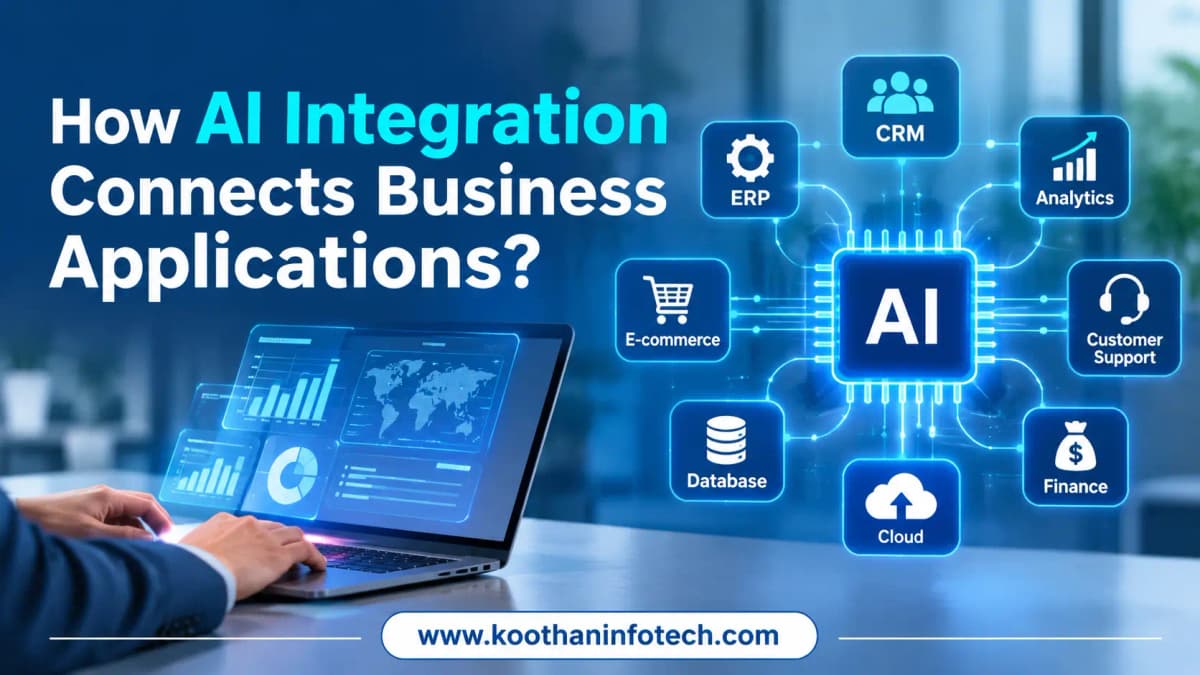
AI Integration Services help businesses connect artificial intelligence with their existing software, applications, and business systems. From automating daily tasks and managing customer enquiries to analysing business data, AI integration helps organisations improve their workflows and reduce manual work.
Koothan Infotech develops AI integration solutions that connect AI technologies with existing business applications based on specific business requirements.
What Are AI Integration Services?
AI Integration Services refer to the process of connecting artificial intelligence technologies with existing business applications, software platforms, databases, websites, and digital infrastructure. These services allow organisations to introduce AI capabilities into their current systems without completely changing their technology setup.
For example, an e-commerce business may receive hundreds of customer enquiries every day. By integrating an AI-powered chatbot with its website, product database, and order management system, the business can automatically answer product-related questions, check order information, and assist customers with common requests.
Similarly, a healthcare organisation can integrate AI document processing into its patient management software to extract information from medical documents and organise records.
AI integration can involve several technologies, including:
Artificial Intelligence (AI)
Machine Learning (ML)
Natural Language Processing (NLP)
Generative AI
Large Language Models (LLMs)
Computer Vision
Predictive Analytics
Retrieval-Augmented Generation (RAG)
AI Agents
Application Programming Interfaces (APIs)
Cloud Computing
The integration process depends on the existing software, available data, business requirements, security policies, and expected outcomes.
Why Do Businesses Need AI Integration?
Businesses often use multiple applications to manage different departments. Sales teams use CRM platforms, marketing teams work with campaign management tools, finance teams handle accounting software, and customer support teams use helpdesk applications.
When these systems operate independently, employees may need to transfer information manually, check multiple platforms, and repeat the same activities.
AI integration connects these systems and introduces intelligent features into existing workflows.
Here are some reasons businesses consider AI integration.
1. Reduce Repetitive Manual Work
Employees spend considerable time handling routine activities such as entering customer information, sorting documents, responding to common enquiries, and preparing reports.
AI-powered automation can handle many of these repetitive tasks based on predefined instructions and business rules.
2. Improve Customer Communication
AI chatbots and virtual assistants can respond to customer questions, provide product information, retrieve order details, and direct enquiries to the appropriate department.
When connected with CRM and business databases, these systems can provide responses based on relevant customer information.
3. Connect Different Business Applications
AI integration helps businesses connect multiple applications through APIs, middleware, and data pipelines.
This allows information to move between systems and supports coordinated workflows across departments.
4. Make Better Use of Business Data
Businesses collect information from websites, applications, customer interactions, transactions, and internal systems.
AI models can analyse this information to identify patterns, generate summaries, estimate future demand, and support business decisions.
5. Improve Operational Efficiency
By reducing repetitive activities and connecting disconnected systems, businesses can improve how employees manage their daily responsibilities. The amount of improvement depends on integration quality, data availability, and how well the solution fits the existing workflow.
Types of AI Integration Services
AI integration covers different technologies and implementation methods. Businesses can select the required integration based on their software infrastructure and operational needs.
1. Generative AI Integration
Generative AI integration connects language and content generation models with existing business applications.These models can understand instructions, process information, generate text, summarise documents, and assist employees with information-related tasks.
Common applications include:
AI content generation tools
Automated email response systems
Document summarisation
Internal knowledge assistants
AI-powered customer support
Business report generation
Conversational search applications
For example, a company can connect a generative AI model with its internal knowledge database. Employees can ask questions in natural language and receive answers based on approved company documents.
2. Machine Learning Integration
Machine learning integration introduces predictive models into existing applications.These models analyse historical and current data to identify patterns and estimate possible outcomes.
Common applications include:
Customer behaviour prediction
Sales forecasting
Fraud detection
Product recommendations
Customer segmentation
Demand forecasting
Risk analysis
For example, an online retail platform can integrate a recommendation model with its product catalogue to suggest relevant products based on customer activity.
3. Natural Language Processing Integration
Natural Language Processing allows software applications to understand and process human language.NLP integration can be used to analyse customer messages, extract information from documents, classify support tickets, and identify customer sentiment.
Common applications include:
Text classification
Sentiment analysis
Language translation
Information extraction
Voice-to-text processing
Intelligent search
Automated ticket categorisation
A customer support platform can use NLP to identify the subject of incoming messages and direct them to the appropriate support team.
4. AI Chatbot Integration
AI chatbot integration connects conversational AI systems with websites, mobile applications, CRM platforms, and business databases.
These chatbots can understand customer questions and retrieve relevant information from connected systems.
Features may include:
Automated customer conversations
Product information retrieval
Appointment scheduling
Order status updates
Lead qualification
Frequently asked question responses
Customer enquiry routing
Businesses can use chatbot integration to manage common customer interactions while allowing human employees to handle complex requests.
5. AI Agent Integration
AI agents are software systems that can interpret instructions, use connected tools, retrieve information, and perform defined tasks within an approved workflow.Unlike a basic chatbot that primarily responds to questions, an AI agent can interact with business applications to complete multi-step activities.
Examples include:
CRM data updates
Lead information collection
Meeting scheduling
Customer enquiry processing
Internal document retrieval
Sales workflow assistance
Business task coordination
For example, an AI sales agent can collect information from a potential customer, check the CRM for existing records, update lead details, and notify the relevant sales representative.
6. Computer Vision Integration
Computer vision allows applications to analyse and interpret visual information such as images, videos, and scanned documents.
Businesses can connect computer vision models with their existing applications to automate visual inspection and information extraction.
Common applications include:
Product defect identification
Image classification
Document image processing
Object detection
Video analysis
Facial recognition where legally permitted
Visual quality inspection
Manufacturing businesses can integrate computer vision with production systems to identify product defects during inspection.
7. Predictive Analytics Integration
Predictive analytics uses historical data, statistical methods, and machine learning models to estimate future trends and outcomes.
Businesses can integrate predictive analytics into dashboards, CRM platforms, ERP systems, and reporting applications.
Examples include:
Sales forecasting
Inventory prediction
Customer churn analysis
Financial forecasting
Equipment maintenance prediction
Market demand analysis
These insights can help management teams plan business activities using available data.
How Does AI Integration Work?
AI integration involves multiple technical stages. Each stage helps connect the required AI technology with the existing business environment.
Step 1: Business Requirement Analysis
The first step is understanding the business process that needs AI integration. The development team evaluates current software, operational challenges, data sources, user requirements, and expected results.
For example, a company may want to automate customer enquiries, connect its CRM with an AI assistant, or introduce predictive reporting into its existing dashboard.
Step 2: Existing System Assessment
The next stage involves reviewing the current technology infrastructure.
This may include:
Websites and web applications
Mobile applications
CRM and ERP platforms
Databases
Cloud infrastructure
Third-party software
Existing APIs
Data storage systems
The assessment helps identify suitable integration methods and possible technical limitations.
Step 3: AI Model and Technology Selection
The appropriate AI technology is selected according to the intended application.A chatbot may require a large language model, while image inspection may require a computer vision model.
Technology selection can involve open-source models, commercial AI APIs, custom machine learning models, or existing enterprise AI platforms.
Step 4: API and Data Integration
APIs allow different applications to communicate and exchange information.During this stage, the AI system is connected with the required databases, software applications, and external platforms.
Developers may also create data pipelines to collect, clean, transform, and transfer information between connected systems.
Step 5: AI Model Configuration
The selected AI model is configured according to the business use case.This may involve prompt engineering, model fine-tuning, retrieval-based knowledge access, business rules, and response validation.
For applications using company documents, a RAG architecture can connect the language model with relevant business information.
Step 6: Testing and Validation
The integrated solution is tested to evaluate its functionality and performance.
Testing may cover:
API communication
Data accuracy
AI response quality
Application performance
User permissions
Security controls
Error handling
Integration reliability
Step 7: Deployment and Monitoring
After testing, the solution is deployed into the required business environment.Continuous monitoring helps identify technical issues, response errors, performance changes, and opportunities for improvement.
AI systems may require updates as business requirements, data, and software environments change.
AI Integration Use Cases Across Different Industries
AI integration can support businesses across multiple industries. The actual implementation depends on industry requirements, available data, and existing applications.
1. Healthcare
Healthcare organisations manage patient records, appointment systems, diagnostic information, billing, and administrative workflows.
AI integration can support:
Patient enquiry chatbots
Medical document processing
Appointment management
Clinical data analysis
Medical image analysis
Healthcare reporting
Administrative workflow automation
For example, an AI assistant integrated with a hospital appointment platform can help patients find available appointment slots and submit booking requests.
Clinical applications require appropriate medical oversight, privacy controls, and validation.
2. Real Estate
Real estate businesses manage property listings, customer enquiries, property documents, appointments, and sales leads.
AI integration can support:
Property recommendation systems
AI-powered property search
Lead scoring
Customer support chatbots
Property price estimation
Document information extraction
Market trend analysis
A real estate platform can connect an AI assistant with its property database to provide relevant listings based on customer requirements.
3. Banking and Finance
Financial organisations process large amounts of transaction data, customer information, and financial documents.
AI integration applications include:
Transaction monitoring
Fraud detection
Customer support automation
Document verification
Financial data analysis
Risk assessment
Automated reporting
AI systems can help identify unusual transaction patterns and highlight activities that require further investigation.
4. E-Commerce
E-commerce businesses manage product catalogues, customer accounts, orders, payments, inventory, and support requests.
AI integration can help with:
Personalised product recommendations
Customer service chatbots
Inventory forecasting
Customer behaviour analysis
Automated product categorisation
Order enquiry processing
Product image analysis
For example, an AI recommendation engine can connect with an e-commerce database and suggest products based on browsing activity and previous purchases.
5. Manufacturing
Manufacturing companies use production management software, inventory systems, quality control applications, and equipment monitoring tools.
AI integration can support:
Predictive maintenance
Visual quality inspection
Production forecasting
Equipment monitoring
Defect identification
Supply chain analysis
Inventory planning
Computer vision models can analyse production images to identify visible defects and notify quality control teams.
6. Education
Educational institutions manage student records, course platforms, examination systems, and communication applications.
AI integration applications include:
AI learning assistants
Automated student enquiry systems
Learning content recommendations
Document processing
Student performance analysis
Course recommendation systems
An AI assistant connected to a learning management system can answer course-related questions using approved educational materials.
7. Logistics and Supply Chain
Logistics businesses coordinate transportation, warehouse operations, shipment information, and delivery schedules.
AI integration can help with:
Route optimisation
Delivery time estimation
Warehouse management
Demand forecasting
Shipment tracking assistance
Inventory prediction
Supply chain reporting
These applications can help logistics teams analyse operational information and coordinate delivery activities.
Technologies Used in AI Integration
The technologies used in an AI integration project depend on the application, infrastructure, data requirements, and model selection.
Some commonly used technologies include:
Programming Languages
Python
JavaScript
TypeScript
Java
Rust
AI and Machine Learning Frameworks
TensorFlow
PyTorch
Scikit-learn
Hugging Face Transformers
Large Language Models
OpenAI models
Google Gemini
Anthropic Claude
Open-source language models
AI Development and Orchestration Tools
LangChain
LlamaIndex
Semantic Kernel
Databases and Vector Storage
PostgreSQL
MongoDB
MySQL
Redis
Pinecone
Weaviate
Chroma
Cloud Platforms
Amazon Web Services
Microsoft Azure
Google Cloud Platform
Integration Technologies
REST APIs
GraphQL
Webhooks
Middleware
Data pipelines
Message queues
Selecting the right technology stack helps businesses build integrations that fit their existing software environment.
Challenges in AI Integration
Although AI integration offers several business applications, organisations need to consider technical and operational challenges before implementation.
1. Data Quality
AI models depend on the information provided to them. Incomplete, outdated, duplicated, or inconsistent data can affect output quality.
Businesses should review and organise their data before connecting AI systems.
2. Legacy Software Compatibility
Older business applications may not support modern APIs or direct integration methods.Developers may need middleware, custom connectors, or additional data processing components to connect these systems.
3. Data Security and Privacy
AI integration may involve customer information, financial records, employee data, or confidential business documents.
Organisations should implement authentication, access controls, encryption, secure data transfer, and suitable data retention policies.
4. Integration Costs
The overall cost depends on the number of applications, model usage, development requirements, cloud infrastructure, and ongoing maintenance.Businesses should define the required features and expected usage before estimating project costs.
5. AI Accuracy and Monitoring
AI models may produce incorrect or incomplete responses.Organisations should use testing, validation, human review, monitoring, and suitable fallback processes, especially for important business operations.
6. Employee Adoption
Employees may need training to work with newly integrated AI features.Clear documentation, user guidance, and practical training can help teams understand how the new systems fit into their daily responsibilities.
How to Choose the Right AI Integration Partner?
Selecting a development partner is an important part of an AI integration project. Businesses should evaluate the technical capabilities and project experience of the development team.
Consider the following factors:
Understanding of Existing Business Systems: The development partner should understand your current software, databases, workflows, and integration requirements.
AI Technology Knowledge: Evaluate experience with machine learning, generative AI, NLP, computer vision, language models, and AI agents.
API Development Experience: API knowledge is important for connecting different applications and transferring information between systems.
Data Security Practices: Discuss authentication, access permissions, encryption, data storage, and privacy requirements.
Testing and Maintenance: Check whether the development team provides integration testing, deployment assistance, monitoring, and ongoing technical support.
Custom Development Capabilities: Every organisation has different software requirements. A suitable partner should be able to develop integrations based on the business's existing infrastructure.
AI Integration Services by Koothan Infotech
Koothan Infotech helps businesses introduce artificial intelligence into their existing technology infrastructure through custom AI integration and development solutions.As an AI Development Company, Koothan Infotech works on AI-powered applications, intelligent automation, AI agents, and software integrations based on business requirements.Our approach focuses on understanding existing applications and identifying where artificial intelligence can support business operations.
Generative AI Integration
Connect generative AI models with websites, applications, internal knowledge bases, and business platforms to support content generation, information retrieval, and document processing.
AI Chatbot Integration
Develop and connect AI chatbots with websites, mobile applications, CRM systems, and customer databases to manage customer enquiries and support requests.
AI Agent Development and Integration
Build AI agents that interact with connected applications, retrieve business information, and perform defined tasks through approved workflows.
Machine Learning Integration
Integrate machine learning models into business applications for forecasting, classification, recommendation systems, and data analysis.
RAG-Based AI Integration
Connect language models with company documents, databases, and knowledge repositories to generate responses using relevant business information.
API-Based AI Integration
Connect AI models with existing software through APIs, webhooks, and custom integration components.
Custom AI Software Integration
Develop AI-powered features for existing business applications based on specific operational requirements.
Benefits of Working with Koothan Infotech
Businesses require AI solutions that fit their software environment and operational processes.Koothan Infotech focuses on developing AI integration solutions based on the following areas:
Business requirement analysis
Existing software assessment
AI model selection
API and database integration
Custom AI application development
AI chatbot and agent development
Integration testing
Deployment and technical support
Whether you want to connect an AI chatbot with your CRM, integrate a language model with internal documents, or introduce machine learning into an existing application, the development approach can be planned according to your requirements.
Conclusion
Artificial intelligence can support many business activities, from customer communication and document processing to predictive analytics and workflow automation. However, businesses need the right integration approach to connect AI technologies with their existing applications.
AI Integration Services provide a way to introduce intelligent features into current software systems without rebuilding the entire technology infrastructure. By selecting suitable AI models, connecting relevant data sources, implementing APIs, and monitoring system performance, organisations can develop AI-powered workflows that support their daily operations. Koothan Infotech works with businesses to develop and integrate AI solutions based on their software environment and business requirements.
Looking to integrate AI into your existing business application? Contact Koothan Infotech to discuss your AI integration requirements and explore a suitable development approach.