


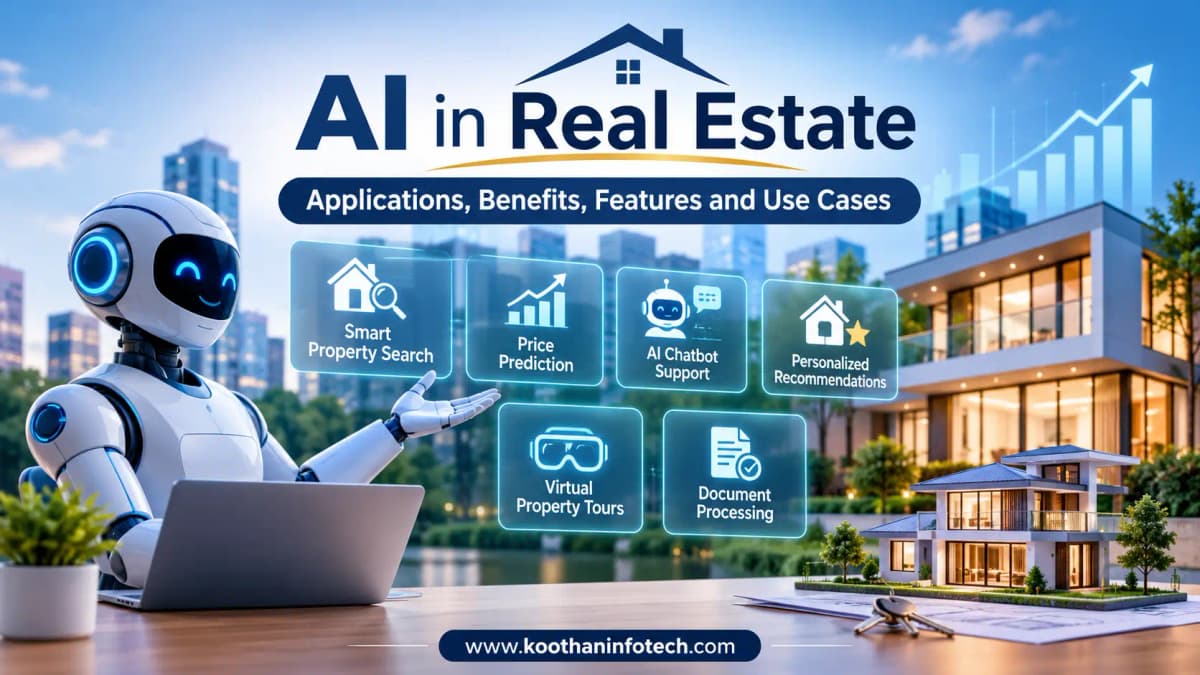
The real estate industry involves property listings, buyer enquiries, site visits, price negotiations, documentation, sales and property management. Handling these activities manually can take considerable time, especially when businesses manage multiple properties and customer enquiries.
AI in Real Estate helps businesses handle these activities through intelligent software, predictive analytics, automation and AI-powered agents. From answering buyer questions and recommending properties to estimating property values and analysing market trends, AI supports different stages of real estate operations.
With custom AI solutions, real estate companies can improve customer communication, organise property information and manage daily business activities more effectively.
What Is AI in Real Estate?
AI in Real Estate refers to the use of artificial intelligence technologies to perform, support and improve activities across the property industry. It uses technologies such as machine learning, natural language processing, computer vision, predictive analytics and generative AI to process information and assist users.
For example, when a buyer searches for a three-bedroom apartment in Madurai within a specific budget, an AI-powered property recommendation system can analyse available listings and suggest properties based on location, price, property type, amenities and buyer preferences.
Similarly, a real estate chatbot can respond to customer enquiries, an AI valuation tool can estimate property prices, and a property management system can identify maintenance requirements.
AI can support residential real estate, commercial real estate, industrial properties, land sales, rental properties and property investment businesses.
How Does AI Work in the Real Estate Industry?
AI systems work by collecting information, identifying patterns, processing user requests and generating relevant results. The type of technology used depends on the business requirement.
The following technologies are commonly used in real estate applications.
1. Machine Learning
Machine learning enables software to identify patterns in property data and improve predictions based on available information.
In real estate, machine learning can analyse historical property prices, location details, demand, property features and transaction records.
For example, a property price prediction system can study previous transactions in a particular neighbourhood and estimate the possible market value of a similar property.
2. Natural Language Processing (NLP)
Natural Language Processing enables computers to understand and process human language.
Real estate businesses receive enquiries through websites, WhatsApp, email and other communication channels. NLP helps AI systems understand questions such as:
What is the price of this apartment?
Do you have two-bedroom flats near the city centre?
Is this property available for rent?
What amenities are included?
Can I schedule a property visit this weekend?
The system can identify the customer's requirements and provide relevant answers using available property information.
3. Computer Vision
Computer vision allows software to analyse images and videos.
In real estate, this technology can be used to examine property photographs, identify rooms, recognise building features, analyse construction progress and support virtual property inspections.
For example, an image analysis system can identify visible features such as swimming pools, balconies, parking areas, gardens and interior spaces from property images.
4. Predictive Analytics
Predictive analytics uses historical and current data to estimate future outcomes.
Real estate businesses can use it to study:
Future property demand.
Rental price movements.
Potential investment locations.
Property sales trends.
Customer buying patterns.
Maintenance requirements.
These predictions provide additional information for business planning and investment decisions. Actual outcomes may vary depending on market conditions.
5. Generative AI
Generative AI creates new content based on user instructions and available information.
Real estate companies can use it to prepare property descriptions, marketing content, customer responses, listing summaries, email messages and property reports.
For example, a real estate agent can provide property details such as location, square footage, number of bedrooms and amenities. A generative AI application can prepare a structured property description for a listing website.
Why Is AI Becoming Important in Real Estate?
Real estate businesses deal with large amounts of information, including property records, customer details, pricing information, location data, legal documents and transaction histories.
Managing this information manually becomes difficult when the business expands.
AI provides practical support in several areas:
High enquiry volumes: AI agents can respond to common customer questions without requiring an employee to answer every message.
Property discovery: Recommendation systems can identify listings that match buyer requirements.
Market research: Data analysis tools can process property information and identify pricing patterns.
Sales management: Lead scoring systems can help sales teams prioritise potential buyers.
Property operations: AI-powered systems can organise maintenance requests and rental information.
Marketing activities: Generative AI can assist with listing descriptions, campaign content and customer communication.
AI does not replace the need for real estate professionals. Property agents, brokers, developers, legal professionals and managers continue to handle important decisions, negotiations and customer relationships.
Key Applications of AI in Real Estate
AI can be applied across almost every stage of the real estate business. The following applications explain how different AI solutions work in practical situations.
1. AI-Powered Property Search
Traditional property searches usually depend on filters such as location, budget, property type and number of bedrooms.
AI-powered property search systems can understand more detailed requirements expressed in natural language.
For example, a customer may search:
"I need a three-bedroom apartment near a school in Madurai, with parking facilities and a budget of ₹75 lakh."
The AI system can understand these requirements and identify matching properties from the available listings.
Key capabilities:
Natural language property searches.
Location-based property recommendations.
Budget-based filtering.
Property feature matching.
Personalised search results.
Similar property suggestions.
This makes property discovery easier for buyers and tenants.
2. AI Property Valuation
Property valuation is an important activity for buyers, sellers, investors and real estate agencies.
An AI property valuation system analyses different factors to estimate the potential market value of a property.
These factors may include:
Property location.
Land area and built-up area.
Number of bedrooms and bathrooms.
Building age.
Property condition.
Nearby infrastructure.
Historical transaction prices.
Current market demand.
Available comparable property listings.
For example, an AI valuation application can compare a residential property with similar properties recently sold in the same locality.
The system can generate an estimated price range based on the available data.
However, AI valuation is an estimate, not a guaranteed selling price. Physical inspections, legal verification and professional valuation may still be required.
3. AI Real Estate Chatbots
Real estate companies receive enquiries throughout the day. Customers may ask about property prices, availability, amenities, payment schedules and site visits.
An AI chatbot can handle these frequently asked questions through a website or messaging platform.
Unlike a basic rule-based chatbot, an AI-powered chatbot can understand different ways of asking the same question and generate responses using connected property information.
Common chatbot functions:
Answer property-related questions.
Share property listing details.
Collect buyer requirements.
Provide location information.
Capture customer contact details.
Schedule appointments.
Forward complex enquiries to sales representatives.
For example, when a customer asks about an available villa, the chatbot can retrieve the relevant listing details and share them directly.
4. AI Lead Generation and Lead Scoring
Lead generation is an important part of real estate sales. However, not every enquiry represents an immediate buying opportunity.
AI-powered lead scoring systems analyse customer interactions and available information to help sales teams identify potential buyers.
The system may consider:
Customer budget.
Preferred property location.
Property type.
Enquiry frequency.
Website activity.
Property views.
Previous communication.
Site visit requests.
Purchase timeline.
Based on these details, the system can classify leads according to their potential level of interest.
For example, a customer who repeatedly views a particular apartment, asks about payment options and requests a site visit may receive a higher priority than someone who has only downloaded a brochure.
Sales teams can use these insights to plan follow-ups and allocate their time more effectively.
5. AI-Powered Property Recommendations
Property recommendation systems suggest relevant listings based on customer interests and previous search behaviour.
For example, a buyer may initially search for apartments in one locality. After analysing the buyer's budget, preferred amenities, property size and search history, the system can suggest similar properties in nearby locations.
Important recommendation factors include:
Budget compatibility.
Preferred location.
Property category.
Floor area.
Number of bedrooms.
Nearby facilities.
Customer search history.
Previously viewed properties.
Real estate portals, property marketplaces and property developer websites can use recommendation engines to improve property discovery.
6. AI Virtual Property Tours
Property buyers do not always have the time to visit every property physically.
AI-supported virtual property tours help customers explore properties remotely through interactive images, 360-degree views and virtual walkthroughs.
These applications may include:
360-degree property views.
Interactive room navigation.
Virtual staging.
Furniture placement visualisation.
Room dimension information.
Property feature identification.
For example, virtual staging can show how an empty living room might look with furniture, lighting and interior decorations.
This gives buyers a better understanding of the property's possible appearance before arranging a physical visit.
7. AI Real Estate Market Analysis
Understanding market conditions is important for property developers, investors, brokers and real estate consultants.
AI-based market analysis tools can process large datasets to identify property trends and market movements.
They can analyse:
Property transaction records.
Historical sale prices.
Rental rates.
Local development activities.
Infrastructure projects.
Population growth.
Employment opportunities.
Property demand.
Available property supply.
For example, an investor comparing two locations can use a market analysis application to review historical prices, rental demand and nearby infrastructure developments.
The findings can support investment research, although future market performance cannot be guaranteed.
8. AI-Powered Property Management
Property management includes rent collection, tenant communication, maintenance requests, property inspections and lease administration.
AI-powered property management software can organise these activities through a central system.
Common applications include:
Automated rent reminders.
Tenant enquiry management.
Maintenance request classification.
Lease document extraction.
Rental payment tracking.
Property inspection scheduling.
Maintenance requirement predictions.
Tenant communication support.
For example, when a tenant reports an electrical issue through a property management application, an AI system can identify the maintenance category, record the request and assign it to the appropriate maintenance team.
9. AI Document Processing
Real estate transactions involve multiple documents, including sale agreements, rental agreements, title deeds, registration documents, property tax records and identity verification documents.
AI-powered document processing systems can extract relevant information from these documents using optical character recognition (OCR) and natural language processing.
Possible functions include:
Document classification.
Text extraction.
Property detail identification.
Contract information summarisation.
Date and amount extraction.
Document comparison.
Missing information identification.
For example, a document processing tool can extract the property address, agreement date, buyer details and payment information from a scanned agreement.
Sensitive documents must be handled with appropriate access controls, privacy protection and human verification. AI extraction does not replace legal review.
10. AI-Powered Real Estate Marketing
Marketing teams need to prepare property descriptions, advertisements, email campaigns, social media posts and promotional materials.
Generative AI tools can assist with these activities using approved property information.
Applications include:
Property listing descriptions.
Social media captions.
Advertisement copy.
Email responses.
Property brochures.
Campaign content variations.
Customer enquiry responses.
Local property content.
For example, a developer launching a new residential project can use an AI content application to create different descriptions for its website, property portal and social media campaigns. All marketing content should be reviewed to confirm that property specifications, pricing and promotional claims are accurate.
Important Features of AI Real Estate Software
When developing an AI application for a real estate business, the features should match its operations, customer requirements and business model.
The following features are commonly useful.
1. Smart Property Search
Allows users to search properties using natural language, location, price range, amenities and property specifications.
2. AI Property Recommendations
Suggests relevant properties based on customer requirements, preferences and browsing activity.
3. Intelligent Chatbot Integration
Provides automated customer assistance through websites, mobile applications and supported messaging channels.
4. Lead Management Dashboard
Collects enquiries, organises customer information, tracks interactions and displays lead status.
5. Automated Appointment Scheduling
Allows customers to request site visits and meeting appointments based on available schedules.
6. Property Price Prediction
Analyses property characteristics and historical market data to estimate property values.
7. Customer Behaviour Analysis
Studies search patterns, listing views and interactions to understand customer interests.
8. Document Intelligence
Extracts and organises information from property agreements, reports and other business documents.
9. Multi-Language Communication
Supports customer enquiries in different languages through language-processing technologies, depending on the languages and models configured.
10. CRM and ERP Integration
Connects AI applications with existing customer relationship management (CRM), enterprise resource planning (ERP), property listing databases and sales management systems.
11. Reporting and Analytics
Provides reports on enquiries, conversions, property performance, customer activity and business operations.
12. Role-Based Access Control
Allows administrators to manage permissions for property agents, sales executives, brokers, managers and other employees.
Real-World Use Cases of AI in Real Estate
The applications of AI differ depending on the type of real estate business. Here are practical examples across different property segments.
Residential Real Estate
Residential developers, property agents and housing companies can use AI to:
Recommend apartments, villas and independent houses.
Answer homebuyer enquiries.
Estimate residential property values.
Schedule property visits.
Analyse buyer preferences.
Generate property descriptions.
Manage customer enquiries.
Commercial Real Estate
Commercial property businesses handle offices, retail spaces, warehouses and business premises.
Commercial property recommendations.
Office space requirement analysis.
Rental price estimation.
Occupancy analysis.
Location comparison.
Tenant enquiry management.
Lease document processing.
Real Estate Investment
Property investors need information about pricing, rental income, market demand and investment locations.
AI-powered analytics applications can assist with:
Property investment research.
Rental yield calculations.
Historical price analysis.
Location comparisons.
Portfolio performance tracking.
Investment scenario analysis.
Market trend identification.
Investment decisions should also consider taxes, financing costs, legal restrictions and market risks.
Property Rental Businesses
Rental agencies and property managers can use AI to manage:
Tenant enquiries.
Rental property searches.
Lease information.
Rent reminders.
Maintenance requests.
Property availability.
Tenant communication.
Real Estate Developers and Builders
Construction companies and property developers can apply AI to:
Construction progress monitoring.
Site image analysis.
Material requirement forecasting.
Project schedule analysis.
Customer enquiry management.
Property launch marketing.
Construction document processing.
Computer vision applications can compare site images over time to help project managers review visible construction progress.
6. Real Estate Brokerages
Brokerage firms manage multiple agents, customers and property listings.
AI applications can support:
Lead distribution.
Agent performance analysis.
Property matching.
Customer follow-up.
Commission reporting.
Listing management.
Sales pipeline analysis.
AI Agents for Real Estate Businesses
AI agents are software systems that can understand requests, use connected tools, retrieve information and perform defined tasks based on business instructions and permissions.
Unlike a simple chatbot that mainly responds to questions, an AI agent can complete a sequence of related activities.
For example, consider a customer who visits a real estate website and says:
"I am looking for a two-bedroom apartment in Madurai within ₹60 lakh."
A real estate AI agent can:
Understand the customer's property requirements.
Search the connected property database.
Identify apartments matching the budget and location.
Present relevant property details.
Answer questions about amenities and availability.
Collect the customer's contact information with consent.
Check available appointment slots.
Request or arrange a site visit.
Update the connected CRM system.
Notify the assigned sales representative.
This workflow reduces repetitive manual work and helps the sales team manage customer enquiries.
Benefits of AI in Real Estate
AI provides several business and operational benefits when implemented according to actual requirements.
1. Faster Customer Responses
AI-powered chatbots and agents can respond to common enquiries without waiting for an employee to become available.
2. Better Property Discovery
Recommendation engines help buyers identify properties that match their requirements instead of manually reviewing unrelated listings.
3. Improved Lead Prioritisation
AI lead scoring helps sales teams identify enquiries that require immediate attention.
4. Reduced Repetitive Work
Automated systems can handle routine tasks such as enquiry classification, information extraction, appointment requests and report preparation.
5. Data-Based Business Decisions
AI analytics can help property businesses understand pricing patterns, customer behaviour and market activity.
6. Better Customer Experience
Personalised recommendations, faster responses and accessible property information can improve the overall customer journey.
7. Organised Property Management
AI-powered platforms can centralise tenant requests, maintenance records, property details and rental information.
8. Improved Marketing Operations
Generative AI can help marketing teams prepare listing content, campaign messages and promotional material.
9. Better Sales Team Productivity
Sales representatives can spend more time on property visits, negotiations and customer relationships while software handles selected repetitive activities.
10. Business Process Visibility
Centralised dashboards provide a clearer view of enquiries, property listings, appointments and sales activities.
Challenges of Implementing AI in Real Estate
Although AI offers several advantages, real estate businesses should understand the challenges before implementing a solution.
1. Data Quality
AI systems depend on the information supplied to them. Incorrect property prices, outdated listings and incomplete customer records can affect the results.
Businesses should maintain accurate and regularly updated databases.
2. Data Privacy and Security
Real estate platforms may process personal information, contact details, financial records and legal documents.
Applications should include appropriate encryption, access permissions, secure storage and data handling practices.
3. Integration with Existing Software
Many real estate businesses already use CRM platforms, property portals, accounting applications and management software.
AI solutions should connect with these systems through suitable APIs and integration methods.
4. Development and Maintenance Costs
The cost of AI development depends on the features, integrations, data requirements, infrastructure and level of customisation.
Businesses should begin with clearly defined requirements rather than investing in unnecessary features.
5. Accuracy and Human Verification
AI-generated property information, valuation estimates and document summaries may contain errors.
Important decisions involving property ownership, legal agreements, pricing and financial transactions should receive appropriate professional verification.
6. User Adoption
Employees may need training to use new AI applications.
A simple interface, practical workflows and proper onboarding can help teams adopt the technology.
Technologies Used to Develop AI Real Estate Applications
Developing a real estate AI application requires different technologies depending on its intended functions.
The technology stack should be selected based on the business use case, data availability, performance requirements and security needs.
How to Develop an AI Solution for a Real Estate Business?
Building an AI-powered real estate application involves more than selecting an AI model. It requires understanding the business workflow and developing a solution that addresses specific operational requirements.
Step 1: Understand the Business Requirements
Identify the main challenges faced by the real estate company.
For example, the business may need an AI chatbot, property recommendation engine, valuation application, lead management agent or property document analysis tool.
Step 2: Collect and Organise Property Data
Prepare the required information, including property listings, prices, locations, amenities, customer enquiries and historical records.
The quality and availability of data influence the application's results.
Step 3: Select the Right AI Technology
Choose suitable technologies based on the required application.
For example, NLP may be used for conversational search, machine learning for property predictions and computer vision for property image analysis.
Step 4: Design the Application Architecture
Define how the AI model, database, APIs, user interface, CRM and other software components will communicate.
Step 5: Develop the AI Model or Agent
Build the required AI functionality, configure its instructions, connect approved data sources and define the tasks it can perform.
Step 6: Integrate Business Applications
Connect the AI application with existing property databases, CRM platforms, communication channels and business software.
Step 7: Test and Validate the Application
Test the application using real business scenarios.
Check response accuracy, property matching, data access, system performance and error handling.
Step 8: Deploy and Monitor
Launch the application and monitor its performance.
Update property information, review AI responses and improve the system based on user feedback and business requirements.
Future of AI in Real Estate
AI adoption in real estate is expected to expand as businesses look for better ways to manage property information, customer relationships and business operations.
Several technology developments are likely to influence the industry.
1. Autonomous Real Estate Workflows
AI agents may handle more connected activities, such as identifying enquiries, retrieving property details, preparing customer summaries and updating CRM records.
Business approval will remain important for actions involving payments, contracts and major decisions.
2. Advanced Property Visualisation
AI-powered virtual staging, 3D visualisation and interactive property tours may help customers understand property layouts and interior possibilities before visiting.
3. Predictive Property Maintenance
Property management applications may use maintenance history, equipment information and sensor data to identify possible maintenance requirements earlier.
4. Intelligent Investment Analysis
AI analytics platforms may combine property transactions, rental information, infrastructure data and market indicators to support investment research.
5. Voice-Based Property Search
Customers may search for properties using voice commands instead of typing long search queries.
Voice-enabled AI systems can understand requirements and retrieve relevant property listings.
6. Connected Smart Buildings
AI can work with Internet of Things (IoT) devices, including smart meters, access systems, temperature sensors and security devices.
This can support energy monitoring, building operations and maintenance management.
7. Personalised Real Estate Platforms
Property platforms may provide more relevant listings, location suggestions and customer communication based on individual requirements and consent-based activity data.
How Koothan Infotech Develops Custom AI Solutions for Real Estate Businesses?
Real estate businesses have different operational requirements. A property developer may need an AI lead generation agent, while a brokerage firm may require intelligent property search and a property management company may need automated tenant communication.
Koothan Infotech develops custom AI solutions based on these business requirements.
We help real estate companies build AI agents, intelligent software applications and AI-powered tools that support property discovery, customer communication, sales operations and property management.
Our development approach focuses on understanding the existing business process and identifying where AI can provide practical value.
Custom AI Agent Development
We develop AI agents for real estate websites and business applications to handle customer enquiries, retrieve property information, qualify leads and support appointment scheduling.
AI Chatbot Development
Our AI chatbot solutions can be configured to answer property-related questions, share listing information, collect customer requirements and connect enquiries with sales representatives.
AI Property Recommendation Systems
We develop recommendation engines that analyse property details and customer preferences to suggest relevant residential and commercial properties.
AI Property Valuation Tools
We build custom valuation applications that use property characteristics, historical records and available market data to estimate property values.
AI Document Processing Solutions
Our AI applications can extract and organise information from property agreements, reports and other business documents.
AI-Powered CRM Integration
We integrate AI capabilities with existing CRM systems to support lead management, customer communication, sales tracking and enquiry analysis.
AI Real Estate Analytics
We develop analytics applications that help businesses study property listings, customer activity, market information and operational performance.
Custom AI Software Development
As an AI Development Company, Koothan Infotech builds custom AI software based on specific real estate business requirements, including web applications, mobile applications, AI agents and third-party integrations.
Whether you operate a real estate agency, property marketplace, construction company, property management business or property development firm, we can help you identify and develop the right AI solution.
Conclusion
AI in Real Estate is changing how property businesses manage listings, communicate with customers, analyse market information and handle daily operations.
From intelligent property search and price estimation to AI agents, document processing and predictive analytics, these technologies offer practical applications across residential, commercial and rental property businesses.However, successful implementation depends on selecting the right use cases, maintaining accurate data and connecting AI applications with existing business processes.
Koothan Infotech helps real estate businesses develop custom AI agents, AI tools and software applications based on their requirements. With the right development approach, property businesses can make better use of their data, organise operations and provide more informed customer experiences.