


Customer expectations have changed significantly in recent years. People want quick answers, convenient communication, and support that is available whenever they need it. For businesses managing hundreds or thousands of customer interactions every day, meeting these expectations with traditional support methods can become difficult.
This is where artificial intelligence is becoming an important part of customer support operations. AI can handle repetitive enquiries, assist support teams, analyse conversations, and help businesses respond to customers more efficiently.
For companies looking to improve service quality while managing growing support volumes, AI in customer services can offer practical benefits across different stages of the customer journey.
What Is AI Powered Customer Service?
AI-powered customer service refers to the use of artificial intelligence technologies to support or automate customer interactions and service-related tasks.These systems can understand customer questions, identify intent, retrieve relevant information, recommend responses, and perform certain actions based on predefined business rules.
Common technologies used in AI-powered customer support include:
AI chatbots
Natural language processing
Machine learning
Generative AI
Speech recognition
Sentiment analysis
Recommendation systems
AI-powered virtual assistants
AI does not necessarily replace human support representatives. In many business environments, it works alongside customer service teams by handling routine work and helping employees focus on conversations that require human judgement.
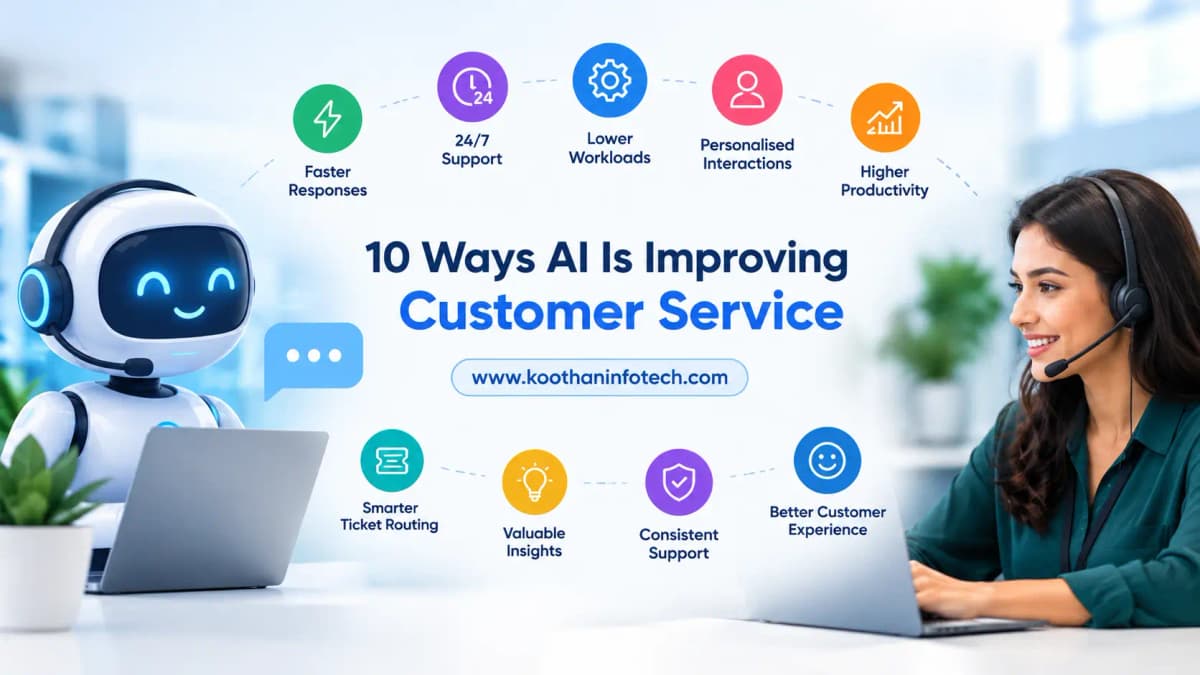
10 Benefits of AI in Customer Service
Explore 10 practical benefits businesses can gain by using AI to improve service quality and support operations.
1. Faster Customer Responses
Response time has a direct impact on customer satisfaction. Long waiting periods can frustrate customers, particularly when they need help with simple questions or common issues.
AI systems can respond to frequently asked questions almost instantly. Customers can receive information about products, orders, account processes, policies, or basic troubleshooting without waiting for a support representative.
For example, an AI assistant can answer questions such as:
Where is my order?
How can I reset my password?
What are your return conditions?
How do I update my account details?
What payment methods do you accept?
Handling these requests automatically allows support teams to spend more time on complex cases.
2. 24/7 Customer Support
Traditional customer service departments usually operate according to working hours or shift schedules. Customers, however, may need assistance at any time.AI-powered support systems can operate around the clock. They can answer routine questions outside normal business hours and provide customers with immediate assistance.
This is particularly useful for businesses serving customers across multiple countries and time zones.A customer who needs basic information late at night does not necessarily have to wait until the next working day. The AI system can provide an answer or collect the required information before transferring the case to a human representative.
3. Lower Customer Support Workload
Customer service teams often spend a large portion of their working hours answering repetitive questions.
AI can take care of many routine interactions, including:
Order status requests
Appointment confirmations
Password-related questions
Account information
Product availability
Basic troubleshooting
Frequently asked questions
Reducing repetitive workloads gives employees more time to handle complaints, technical problems, account-specific issues, and other cases that require deeper attention.The result is a better division of work between automated systems and human support teams.
4. Better Handling of Large Support Volumes
Support demand can change quickly. Product launches, seasonal sales, service interruptions, marketing campaigns, and unexpected events can generate a large increase in customer enquiries.A support team may struggle to respond to every request during these periods.
AI can help manage higher volumes by handling multiple routine conversations simultaneously. Instead of placing every customer in a queue for a human representative, simple requests can be processed automatically.
This can help businesses maintain reasonable response times even when enquiry volumes increase.
5. Personalised Customer Interactions
Customers do not always want generic answers. They expect businesses to understand the context of their questions.
When connected with appropriate business systems, AI can use available customer and interaction data to provide more relevant responses.
For example, an AI support system connected to an e-commerce platform may identify a customer's recent order and provide information related to that specific purchase.
Personalisation can also involve:
Previous support conversations
Customer preferences
Purchase history
Account information
Previous service requests
Product usage patterns
Businesses should, however, apply appropriate data protection practices when using customer information.
6. Improved Support Team Productivity
AI can assist customer service employees instead of interacting directly with customers in every situation.For example, an AI assistant can help a support representative by:
Suggesting responses
Summarising previous conversations
Finding information from a knowledge base
Categorising support tickets
Recommending troubleshooting steps
Identifying customer sentiment
Creating conversation summaries
These capabilities reduce the amount of manual work involved in handling each ticket.Instead of searching through multiple systems for information, employees can receive relevant details within their support workflow.
7. Faster Ticket Classification and Routing
A customer enquiry may need to be handled by a specific department. Sending a billing issue to a technical support team, for example, creates unnecessary delays.AI can analyse incoming messages and identify their likely category or intent.
A support request could be classified as:
Billing
Technical support
Account management
Sales enquiry
Product issue
Refund request
Complaint
The system can then route the ticket to the appropriate team.This reduces unnecessary transfers and helps customers reach the right department more quickly.
8. Useful Insights From Customer Conversations
Customer conversations contain valuable information about what people like, dislike, need, and struggle with.
Manually analysing thousands of conversations is difficult. AI can process large amounts of customer interaction data and identify recurring patterns.
Businesses can use these insights to understand:
Common customer complaints
Frequently requested features
Product problems
Repeated support questions
Changes in customer sentiment
Reasons for customer dissatisfaction
These findings can help product, marketing, sales, and customer service teams make better decisions.For example, if customers repeatedly ask how to use a particular feature, the business may need to improve its documentation or redesign part of the product.
9. Consistent Customer Support
When several employees handle customer enquiries, responses can differ depending on their experience, workload, or interpretation of company policies.AI-powered support systems can use approved knowledge sources and predefined business rules to provide consistent information.
This can be particularly useful for businesses with large customer service teams.A central knowledge base can provide the information required for common questions, while human representatives can take over when a situation requires judgement or personal attention.
Consistency is especially important for areas such as:
Refund policies
Product information
Account procedures
Shipping policies
Service terms
Troubleshooting instructions
10. Better Customer Experience
The individual benefits of AI ultimately contribute to a broader objective: improving the customer experience.Faster responses, shorter queues, better ticket routing, relevant information, and continuous support can make customer interactions easier.
However, technology alone does not create a good customer experience. Businesses need to design AI support around actual customer needs.A good implementation should make it easy for customers to reach a human representative when automated support cannot resolve their problem.
The goal should not be to automate every conversation. The goal should be to make the overall support process more efficient and convenient.
How Businesses Can Use AI in Customer Support?
AI can be introduced at different stages of the customer support process.
Customer Enquiry Management
AI chatbots and virtual assistants can handle common questions and guide customers towards relevant information.
Support Ticket Management
AI can classify, prioritise, and route tickets according to their subject and urgency.
Agent Assistance
Support representatives can use AI tools to retrieve information, generate response suggestions, and summarise conversations.
Customer Feedback Analysis
AI can analyse reviews, surveys, chat conversations, and support tickets to identify common themes and sentiment.
Knowledge Management
AI can help customers and employees find relevant information from internal documentation and knowledge bases.
Best Practices for Implementing AI in Customer Service
Businesses should focus on practical implementation rather than adopting AI simply because it is becoming popular.
Start With Repetitive Tasks
Identify support activities that consume significant employee time but do not require complex decision-making.
These are often the best starting points for automation.
Keep Human Support Available
AI should not become a barrier between customers and support representatives.Give customers a clear option to speak with a human when the issue is complicated, sensitive, or unresolved.
Use Reliable Knowledge Sources
AI systems should work with accurate and regularly updated business information. Outdated product details or policies can result in incorrect customer responses.
Protect Customer Information
Customer data should be handled according to applicable privacy and security requirements. Access controls, monitoring, and appropriate data-handling procedures should be part of the implementation.
Monitor AI Performance
Businesses should regularly review metrics such as:
First response time
Resolution time
Customer satisfaction
Escalation rate
Ticket volume
AI resolution rate
Human handoff rate
These measurements help identify where the system is performing well and where improvements are needed.
Choosing an Best AI Development Company
Businesses planning to build or integrate an AI-powered customer service solution should evaluate the technical capabilities of an AI Development Company before starting the project.
Important areas to assess include:
Experience with conversational AI
Natural language processing capabilities
AI model integration
CRM and helpdesk integrations
Data security practices
Knowledge base integration
Human handoff functionality
Analytics and reporting
Post-launch maintenance
The right development partner should understand both the technology and the business workflow. A customer service solution needs to fit existing operations rather than forcing employees to completely change how they work.
How Koothan Infotech Approaches AI Solutions?
At Koothan Infotech, AI solutions can be developed around specific business requirements, customer interaction workflows, and operational goals.The focus can include conversational systems, AI assistants, workflow automation, data processing, and integrations with existing business applications.
Before developing a solution, businesses should identify where customer support teams spend the most time, which interactions can be automated, and where human involvement remains necessary.This approach helps create an AI system that supports the existing customer service process rather than adding another disconnected tool.
Final Thoughts
AI is becoming an important part of modern customer service because it can help businesses respond faster, manage higher support volumes, assist employees, and gain useful insights from customer interactions.The strongest results come from using AI where it adds genuine value. Routine enquiries can be automated, while complex or sensitive conversations can remain with human representatives.
For businesses considering AI adoption, the starting point should be clear: identify customer service problems first, then determine where AI can solve them effectively.When implemented with the right technology, data practices, and human oversight, AI can become a practical part of a modern customer support strategy.