


Artificial Intelligence is not something you see in movies anymore. It is something that businesses really need to have. A lot of companies are using Artificial Intelligence to make their work easier, make their customers happy, make decisions and find new ways to make money. But for Artificial Intelligence to really work it is not about the technology it is also about how well it is made from the start.
If you are making something with Artificial Intelligence like a computer program that can talk to people, a program that suggests things to buy, a program that can predict what will happen or a program that helps big companies do their work you have to think about what's important when you are making it. You want to make sure it is something that can grow and change as your business changes and that it will still be good for a time.
Top 6 Features In AI Development Company
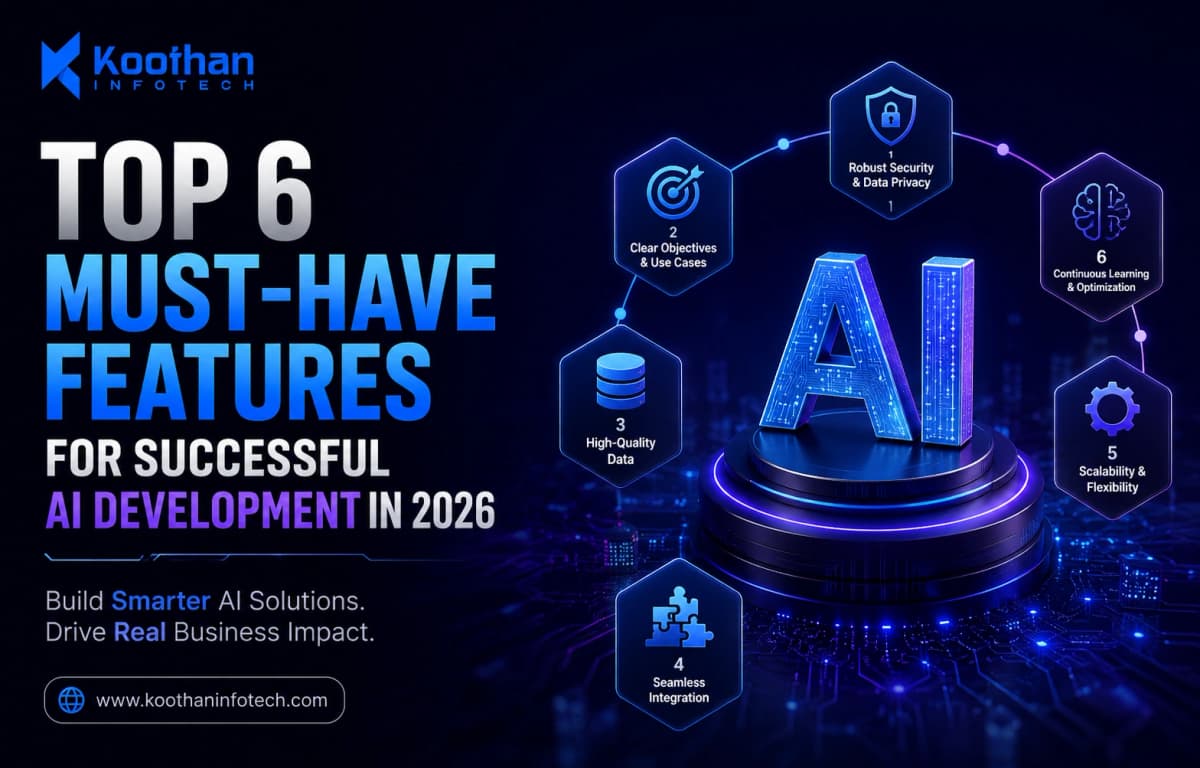
This guide explores the top six must-have features for successful AI development in 2026, helping businesses understand what truly matters before investing in an AI solution.
1. Scalable Architecture for Future Growth
One of the mistakes businesses make is creating Artificial Intelligence applications that work well today but have trouble working well tomorrow. When more people use these Artificial Intelligence applications and the data they use gets more complicated the Artificial Intelligence systems need to be able to handle the work without slowing down.
Having a system that can handle growth is really important for businesses. This way businesses can add Artificial Intelligence capabilities, use new technologies and handle more work without any problems. A lot of companies are now using Cloud- infrastructure, modular development and microservices-based architecture to build new Artificial Intelligence solutions.
Being able to handle growth is also good because it saves businesses money in the run and makes sure the Artificial Intelligence applications are still useful as the businesses change and grow. This is important for AI applications because they need to keep working as the businesses get bigger and the Artificial Intelligence applications get more complicated.
Why it matters:
Supports increasing workloads
Improves long-term performance
Enables seamless feature expansion
Reduces infrastructure limitations
2. Robust Data Security and Privacy
Artificial Intelligence relies heavily on data, making security one of the most critical components of successful AI development. Sensitive customer information, financial records, and proprietary business data must be protected throughout the AI lifecycle.
Modern AI applications should incorporate encryption, secure APIs, role-based access control, authentication mechanisms, and compliance with industry regulations. Privacy-by-design has become an essential development principle rather than an optional feature.
Organizations that prioritize AI security not only protect valuable data but also strengthen customer trust and regulatory compliance.
Key security features include:
End-to-end encryption
Multi-factor authentication
Secure cloud storage
Data anonymization
Compliance-ready architecture
3. Intelligent Automation and Decision-Making
The primary objective of AI is not simply to automate repetitive tasks but to make smarter business decisions. Intelligent automation enables AI systems to analyze patterns, identify anomalies, and execute actions with minimal human intervention.
Businesses increasingly expect AI applications to optimize workflows, reduce operational costs, and improve productivity through real-time decision-making. Features such as predictive analytics, workflow automation, and machine learning models allow organizations to gain actionable insights from large datasets.
By integrating intelligent automation into AI applications, businesses can improve operational efficiency while delivering faster and more accurate outcomes.
Benefits include:
Reduced manual effort
Faster processing
Improved operational efficiency
Better business insights
Higher productivity
4. Seamless Integration with Existing Business Systems
An AI application should complement existing business processes rather than replace them entirely. Integration capabilities determine how effectively AI can communicate with enterprise software such as CRM platforms, ERP systems, cloud services, payment gateways, and third-party APIs.
Modern AI solutions should be designed with flexible APIs that simplify data exchange across multiple platforms. This allows businesses to implement AI without disrupting existing workflows or requiring extensive infrastructure changes.
Smooth integration also improves data consistency, reduces operational complexity, and accelerates digital transformation initiatives.
Essential integration capabilities include:
RESTful APIs
Cloud connectivity
CRM integration
ERP compatibility
Third-party software support
Real-time data synchronization
5. Personalized User Experience
AI applications are getting more focused on customers. Personalization has become one of the features of good AI tools in 2026.
By using machine learning methods and looking at how people behave, AI systems can offer suggestions, smart search results, custom dashboards and changing user interfaces.
Whether it is a store suggesting items or a health app giving special information personalization makes users more involved and happier.
Companies that focus on experiences usually get more customers to stay and have better chances, against others.
Popular personalization features include:
Smart recommendations
Adaptive interfaces
Behavioral analysis
Customer segmentation
Predictive suggestions
6. Continuous Learning and Performance Optimization
Unlike traditional software, AI applications should continuously improve as they process new information. Continuous learning enables AI models to adapt to changing environments, user behaviors, and market conditions without requiring complete redevelopment.
Regular model retraining, performance monitoring, and feedback analysis ensure that AI systems remain accurate, reliable, and effective over time.
Organizations should also monitor key performance indicators such as prediction accuracy, response time, and model efficiency to maintain consistent performance.
Continuous optimization helps businesses maximize return on investment while keeping AI applications aligned with evolving customer expectations.
Core optimization practices include:
Model retraining
Performance analytics
Feedback loops
Accuracy monitoring
Continuous updates
Why These Features Matter More Than Ever?
Artificial Intelligence is no longer seen as a technology; it has become a key part of modern digital transformation plans. Companies that work on building AI applications are searching for solutions that are safe, able to grow, smart and able to change as needed.
Companies that focus on these six qualities while they build their systems are in a better place to create AI tools that can give real business results and can also change as new technology comes along.
Than only thinking about getting things up and running quickly companies should pay more attention to lasting results, safety, how easy it is to use and always finding new ways to improve.
Conclusion:
As AI continues to reshape industries in 2026, successful development requires more than sophisticated algorithms. It demands thoughtful planning, secure architecture, seamless integration, and continuous improvement.
Whether you're building an AI-powered customer support platform, an intelligent automation system, or an enterprise analytics solution, incorporating these six must-have features will significantly enhance performance, scalability, and user satisfaction.
For businesses seeking a reliable technology partner, choosing an experienced AI development company with expertise in custom AI solutions, enterprise software, and intelligent automation can make a substantial difference in project success. At Koothan Infotech, we focus on building scalable, secure, and business-driven AI solutions that align with modern industry requirements while helping organizations accelerate digital innovation.
By adopting a strategic approach to AI solution development, businesses can create future-ready applications that deliver lasting value in an increasingly competitive digital landscape.