


Have you ever wondered what’s common among leading crypto exchanges like Binance, OKX, and Bybit?
A major share of their profits comes from crypto derivatives trading.
While traders use derivatives as tools, entrepreneurs see them as powerful business opportunities. Derivatives significantly boost trading volume, revenue, liquidity, and user engagement, which is why almost every top exchange is expanding in this space.
If you're planning to build a crypto exchange platform, understanding derivatives is not optional—it’s essential.
What are Crypto Derivatives?
Crypto derivatives are financial contracts whose value comes from an underlying cryptocurrency like Bitcoin or Ethereum.
Instead of buying the actual coin, you trade a contract based on its future price.
Easy Example Imagine this:
You and a house owner agree today that next year’s rent will be ₹10,000/month.
If market rent becomes ₹15,000 → You benefit
If it drops to ₹8,000 → Owner benefits
No matter what happens, the price is already fixed.
That’s exactly how a futures contract works.
How Derivatives Work in a Crypto Exchange?
Imagine you’re trading on a platform like Binance, and you see that the current price of Bitcoin is ₹50,00,000. Now, instead of buying Bitcoin directly, you decide to open a futures contract because you think the price will go up. You enter a long position at ₹50,00,000 by placing a small amount called margin, and the exchange allows you to use leverage to control a bigger position.
As the market moves, your profit or loss is calculated based on the price change. If Bitcoin rises to ₹55,00,000, you make a profit; if it drops to ₹45,00,000, you incur a loss. If the loss becomes too large and crosses your margin limit, the exchange automatically liquidates your position to prevent further loss. Throughout this process, you never actually own Bitcoin you’re simply trading a contract that tracks its price movement. This is why derivatives trading is faster, more flexible, and riskier compared to spot trading.
Types of Crypto Derivatives
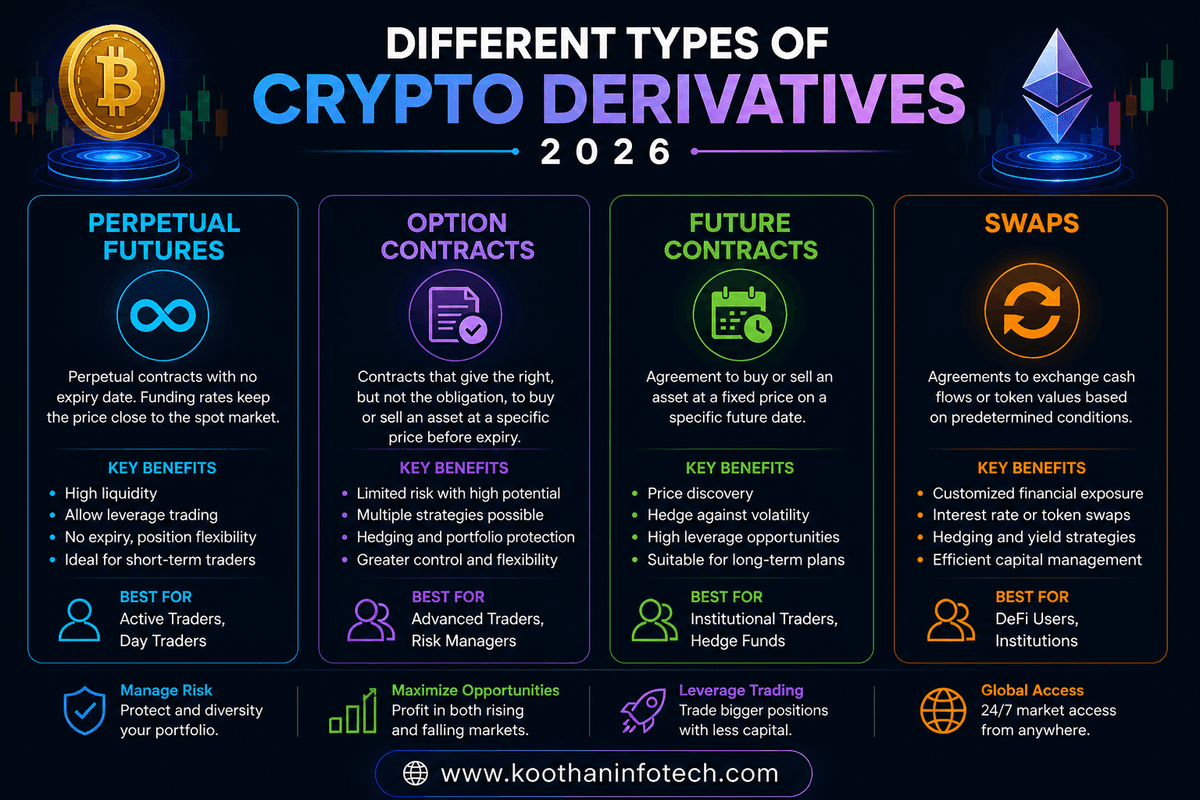
Not all crypto derivatives work the same way. Each type is designed for different trading strategies, risk levels, and business models. Let’s break them down in detail.
Summary
Each derivative type serves a different purpose:
Perpetual Futures → High volume + continuous revenue
Options → Advanced strategies + risk control
Futures → Structured trading + steady activity
Swaps → DeFi growth + on-chain innovation
A successful crypto exchange often combines multiple derivative types to attract different kinds of traders and maximize revenue streams.
1. Perpetual Futures
Perpetual futures (also called perps) are the most popular type of crypto derivative. They work like traditional futures but with one key difference: they don’t have an expiry date.
This means traders can keep their positions open indefinitely, as long as they maintain enough margin to support the trade.Perpetual futures dominate crypto trading because they are simple, flexible, and highly liquid.
Massive trading volume (largest in crypto derivatives)
Keeps traders active for longer durations
Exchanges earn funding fees + trading fees continuously
Ideal for both beginners and professional traders
👉 For businesses, this is the main revenue-driving product in a derivatives exchange.
2. Options Contracts
Options are more advanced financial instruments that give traders flexibility with controlled risk.
An options contract gives the buyer the right, but not the obligation, to buy or sell an asset at a fixed price (called the strike price) before a certain date.
Types of options
Call Option → Right to buy at a fixed price
Put Option → Right to sell at a fixed price
Options are popular among traders who want risk management and strategic trading.
Loss is limited to the premium → controlled downside risk
Used for hedging portfolios
Enables complex strategies (spreads, straddles, etc.)
Attracts institutional and experienced traders
👉 For exchanges, options help expand into high-value, professional trading segments.
3. Futures Contracts
Futures are one of the oldest and most straightforward derivatives.
A futures contract is an agreement to buy or sell an asset at a fixed price on a specific future date.
Key features
Fixed settlement date
Uses margin and leverage
Can be closed before expiry
Futures are widely used due to their simplicity and high trading activity.
Generates consistent trading volume
Appeals to active and professional traders
Easier to understand compared to options
Strong source of transaction fee revenue
👉 Futures are often the entry point for users moving into derivatives trading.
4. Swaps
Swaps are agreements where two parties exchange financial value based on an asset’s performance.
In crypto, swaps are more commonly seen in DeFi (Decentralized Finance) environments.
Types of swaps
Token Swaps
Exchange one crypto for another (e.g., BTC to ETH) on decentralized platforms
Interest Rate Swaps
Exchange fixed and variable interest payments in lending protocols
Cross-Asset Swaps
Gain exposure to another asset without actually owning or selling your current asset
Example:
👉 You hold ETH but want BTC exposure → swap value instead of selling ETH
Steps to Create a Cryptocurrency Derivatives Exchange
Building a crypto derivatives exchange isn’t just about coding it’s a mix of business planning, compliance, technology, liquidity, and user trust. Here’s a clear, practical step-by-step guide.
1. Define Your Business Model
The first step in building a crypto derivatives exchange is clearly defining your business model what you’re offering and who you’re building it for. Start by selecting the types of derivatives you want to provide, such as perpetual futures, traditional futures, options, or swaps, based on your market strategy.
Then identify your target audience, whether it’s retail traders looking for simple tools, institutional investors seeking advanced features, or DeFi users who prefer decentralized trading. Once your audience and product are clear, decide how your platform will generate revenue.
Most derivatives exchanges earn through multiple streams, including trading fees on every transaction, funding fees from perpetual contracts, margin interest on leveraged positions, and liquidation fees when positions are force-closed. A well-defined business model helps you align your product features, pricing strategy, and long-term growth plan right from the start.
2. Market Research & Competitive Analysis
Before building your exchange platform, you need to understand the market and your competitors. Study leading exchanges like Binance and Bybit to see what products they offer, how they generate revenue, and what features attract users the most. This helps you identify what already works and where you can improve.
The key is to find a gap in the market maybe a beginner-friendly platform, advanced tools for institutions, DeFi-focused trading, or a region-specific solution. Your success depends on how well you differentiate your platform from others.
3. Legal & Regulatory Compliance
Legal compliance is one of the most important parts of launching a crypto derivatives exchange. You need to decide where your business will operate and follow the rules of that region. This includes implementing KYC (Know Your Customer) to verify users and AML (Anti-Money Laundering) measures to prevent illegal activities.
Depending on the country, you may also need specific licenses to run your platform legally. Since crypto regulations change often, it’s always best to consult legal experts early. Ignoring compliance can lead to heavy penalties or even shutdown of your platform.
4. Design System Architecture
Once your plan is ready, the next step is to design how your platform will technically function. This includes building the core structure, such as a trading engine to process orders quickly, an order book to display buy and sell activity, and a matching engine to pair trades efficiently.
You also need a risk management system to handle margin, leverage, and liquidation processes. APIs are important for connecting external tools like trading bots. A strong and scalable architecture ensures your platform can handle high traffic and trading volume without issues.
5. Choose Technology Stack
Choosing the right technology is essential for performance and scalability. If you’re building a decentralized exchange (DEX), you can use blockchains like Ethereum, Solana, Arbitrum, or Polygon.
For backend development, technologies like Node.js, Python, or Go are commonly used, while frontend interfaces are built using React or Angular. Databases such as PostgreSQL or MongoDB help manage user and transaction data. For DEX platforms, you’ll also need to develop secure smart contracts and integrate wallets like MetaMask. The right tech stack directly impacts your platform’s speed, cost, and future growth.
6. Build Core Features
Your exchange must include all the essential features that traders expect. This starts with user registration and KYC verification, followed by wallet integration for deposits and withdrawals. A real-time trading interface with charts and multiple order types (market, limit, stop-loss) is crucial.
You also need margin and leverage controls, along with a proper liquidation system to manage risk. For perpetual trading, implementing a funding rate mechanism is important. A smooth and user-friendly interface plays a big role in keeping users engaged and active.
7. Liquidity Setup
Liquidity is what makes your exchange functional and attractive to traders. Without enough liquidity, users will face delays and price differences while trading. To solve this, you can partner with liquidity providers, integrate liquidity from other exchanges, or work with market makers who actively place buy and sell orders.
You can also attract users by offering incentives like rewards or reduced fees. High liquidity ensures faster trades, better pricing, and an overall better user experience.
8. Security Implementation
Security is critical in any crypto platform because it directly affects user trust and funds safety. You should use cold wallet storage to protect assets offline and multi-signature wallets for added security. Features like Two-Factor Authentication (2FA), data encryption, and DDoS protection help secure user accounts and platform access.
If you’re building a DEX, smart contract audits are essential to avoid vulnerabilities. Even a small security issue can lead to major losses, so this step should never be overlooked.
9. Testing & Beta Launch
Before launching your exchange, thorough testing is necessary to ensure everything works smoothly. This includes stress testing to check how the platform handles heavy traffic, as well as security audits to identify potential risks. Running a beta version with real users helps you gather feedback and fix issues early.
This stage allows you to improve performance, remove bugs, and refine the user experience before going public.
10. Launch & Marketing
Once your platform is ready, the next step is to launch and attract users. Building a strong community through platforms like Telegram and Discord helps create engagement and trust.
Partnering with influencers and experienced traders can bring visibility to your platform. Offering referral programs, bonuses, and educational content encourages more users to join and stay active. A strong marketing strategy is essential to gain initial traction and liquidity.
11. Post-Launch Scaling
After launch, your work doesn’t stop. You need to continuously improve and expand your platform. This includes adding new trading pairs, introducing advanced derivative products, and improving platform speed and performance. Expanding to new markets and regions can help grow your user base.
At the same time, staying updated with regulations is important to remain compliant. A successful crypto exchange is one that keeps evolving based on market trends and user needs.
Advantages of Launching a Crypto Derivatives Platform
Multiple revenue streams – Earn from trading fees, funding fees, margin interest, and liquidation fees
High trading volume – Derivatives attract frequent and large trades
Attract professional traders – Bring in institutions and experienced users
Better user engagement – Advanced tools keep traders active longer
Fast-growing market – Increasing demand from global investors and hedge funds
Leverage trading demand – Users prefer trading with less capital and higher exposure
Innovation opportunities – Add AI trading bots, cross-chain features, and new derivatives
Global reach – Access users and liquidity from multiple countries
Stronger brand positioning – Stand out from basic crypto exchanges
Conclusion
Crypto derivatives are more than just trading instrumentsthey are a powerful opportunity for businesses to build high-growth crypto platforms. With products like futures, options, perpetuals, and swaps, you can create multiple revenue streams, attract professional traders, and scale globally. However, success in this space depends on strong technology, proper compliance, effective risk management, and, most importantly, user trust.
If you’re planning to enter this market, partnering with the right cryptocurrency development company can make all the difference. Koothan Infotech, offers advanced crypto derivatives development services tailored to your business needs. From strategy and design to development and launch, their expert team helps you build a secure, scalable, and future-ready derivatives platform.